

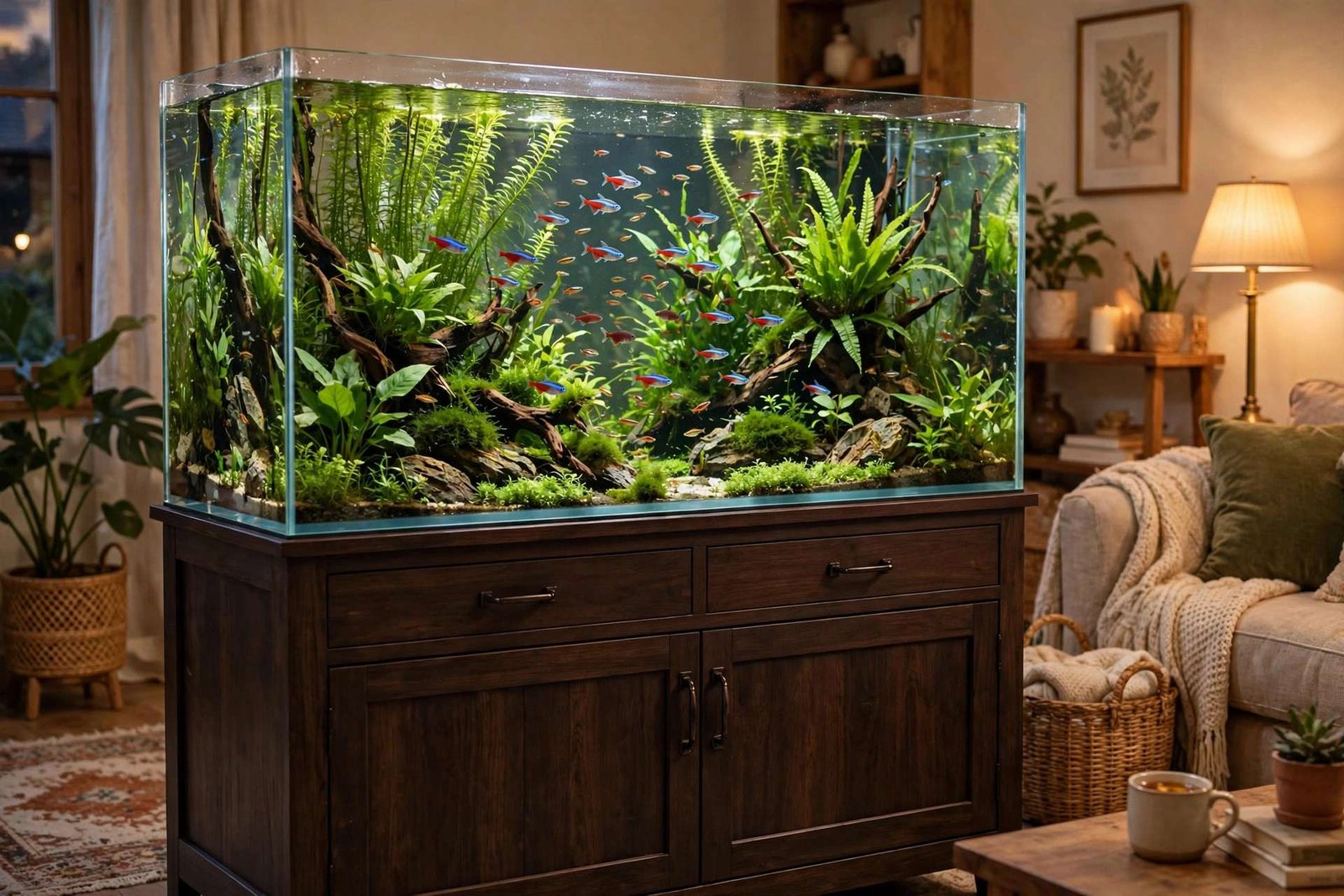
Here's the number that changes how you think about your tank: a gallon of water weighs about 8.3 pounds. Your "little" 20-gallon tank — glass, gravel, rocks, filter, and water included — sits at roughly 225 pounds. A 55-gallon setup pushes past 600.
That weight never moves. And the thing holding it up — the stand — is the part most people think about last.
Here is how heavy your tank really is, what makes a stand safe, and which type to buy.
How Much Does a Filled Fish Tank Actually Weigh?
Water runs about 8.34 pounds per gallon; add the glass tank, substrate, decorations, and equipment, and here's what common tanks really weigh set up and filled:
- 10 gallon: ~110–115 lbs — about the weight of a full-grown adult
- 20 gallon: ~220–230 lbs — like two adults standing on your furniture, permanently
- 40 gallon: ~450–470 lbs — heavier than most refrigerators
- 55 gallon: ~600–630 lbs — a grand piano's worth of weight on a 4-foot footprint
Substrate adds more than you'd think — a 2-inch gravel bed in a 20-gallon tank can weigh 20+ pounds. Choose it deliberately; my aquarium gravel guide covers the right depth and type: https://fishaccessories.net/aquarium-gravel/
Add up the real weight, then buy a stand rated comfortably above it.
Can You Just Use a Dresser, Table, or Shelf?
Honest answer: sometimes yes, usually no, and the bigger the tank the harder the no.
A 10-gallon tank on a solid-wood dresser can be fine — if the dresser is genuinely solid, the top is flat, and the tank's footprint sits fully on it with no overhang. But most modern furniture is designed to hold folded shirts, not 200+ pounds of water pressing down in one spot around the clock, with the occasional splash soaking in.
Furniture fails predictably: particleboard swells and sags when wet, shelves bow in the middle, and sturdy-looking backs are often decorative. As the Environmental Literacy Council's stand FAQ notes, dressers generally lack the support a filled tank needs: https://enviroliteracy.org/animals/what-makes-a-good-aquarium-stand/
Rule of thumb: under 15 gallons on real, flat, solid wood, you can make it work. Anything bigger deserves a stand built for the job.
The 5 Things Every Good Aquarium Stand Must Have
Whatever style you pick, check these five things before you buy.
1. A real weight rating. A good stand is rated at least 20% above your tank's filled weight. No rating listed? Walk away.
2. Full footprint support. Every square inch of the tank's bottom frame must rest on the stand — even an inch of overhang concentrates stress and can crack a tank over time.
3. Rigidity. Press the corners in the store — a good stand doesn't rack, twist, or wobble. Cross-bracing or welded steel frames are what you're feeling for.
4. Water resistance. Splashes are inevitable, so look for sealed or laminated surfaces, powder-coated metal, or a wipeable finish. Raw particleboard is the enemy — once it swells, it never goes back.
5. Room for your gear. A stand with a cabinet or open shelf hides filters, heaters, and clutter — just make sure there are cord ports so you're not pinching cables under the tank.
Wood vs. Metal vs. DIY: Which Stand Is Right for You?
Wooden cabinet stands are the living-room choice. They look like furniture, hide all your equipment behind doors, and come sized to match standard tanks. The catch: quality varies wildly. Solid wood or plywood is excellent; a cheap particleboard box that happens to be fish-tank-shaped is a disaster waiting to happen. Check the material, not just the finish.
Metal stands are the workhorses. Welded steel frames with leveling feet hold huge weight for relatively little money, and they shrug off water. They look industrial, which is why you see them in fish rooms more than living rooms. For a 55-gallon or larger tank on a budget, metal is hard to beat.
DIY stands built from 2×4 lumber and plywood are the strongest option per dollar — overbuilt by design — and hugely popular with serious hobbyists. But "overbuilt" has to be actual engineering, not just enthusiasm. Follow a proven plan, use screws rather than nails alone, and seal every surface against moisture. A bad DIY stand is worse than a cheap store-bought one — at least the store one was rated by somebody.
The Colorado aquarium society's stand guide compares the types and materials if you want to shop around: https://www.tcrascolorado.com/essential-guide-to-aquarium-stands-types-sizes-and-materials/
Getting the Size and Height Right
Sizing a stand is simpler than people make it: match it to your tank's footprint exactly. A 20-gallon high and a 20-gallon long are both "20 gallons" but have completely different footprints — measure your tank's length and depth, then buy the stand made for that footprint (my 20-gallon setup guide lists standard dimensions): https://fishaccessories.net/20-gallon-fish-tank/
Height is about viewing comfort. A stand that puts the tank's center at or slightly below your eye level when seated is the sweet spot for a living room — usually 28 to 32 inches tall. Taller stands look dramatic but make maintenance miserable, and tall tanks on tall stands get top-heavy — anchor them if you have kids or live in an earthquake zone.
Pick the spot before you buy: keep the tank away from windows (algae), exterior doors (temperature swings), and anywhere the floor bounces. For tanks over 55 gallons upstairs, position the stand across multiple floor joists, against a load-bearing wall.
Setting It Up Safely: Leveling Matters More Than You Think
An unlevel tank is a slow-motion disaster: uneven water pressure stresses glass and silicone, and over months that can mean a seam failure. Take leveling seriously:
- Set the empty stand in its final spot and check it with a real spirit level, front-to-back and side-to-side.
- Shim the low spots. Wooden or composite shims under the feet — not folded cardboard.
- For rimless tanks, add a self-leveling foam mat between stand and glass — it absorbs tiny imperfections in the stand top. (Tanks with a plastic frame don't need one.)
- Level it again after the tank is on but before you fill it.
- Fill slowly and re-check the level at half full. A stand can settle under load.
Five minutes with a level now beats a cracked seam later. Beginners skip this step; experienced keepers never do.
5 Signs Your Stand Is in Trouble
Stands rarely fail all at once — they warn you first. Check yours every few months:
- It rocks or wobbles when you bump it. Tighten, shim, or replace — movement and glass don't mix.
- The top is bowing or sagging. The stand is overloaded — move the tank and upgrade.
- Water damage — swelling, peeling laminate, soft spots. Moisture has compromised the structure.
- It leans. A stand that has settled unevenly stresses the tank exactly like a bad initial setup.
- Cracked welds or split joints. Hairline cracks at welds (metal) or joints pulling apart (wood) are retire-it-now signals.
If you spot any of these on a filled tank, don't ignore it: drain down to a few inches, relocate the tank temporarily, and fix or replace the stand before refilling.
Frequently Asked Questions
Can I put a fish tank directly on the floor?
The floor can take the weight, but it's a bad idea otherwise: hard to view, hard to maintain, vulnerable to kicks and spills. A proper stand is worth it.
How tall should an aquarium stand be?
For a living room, 28–32 inches puts a typical tank at comfortable seated viewing height. Go shorter for deep tanks you'll reach into, and anchor anything tall-and-narrow.
Do I need a leveling mat under my tank?
For rimless tanks, yes — a foam mat protects the bottom glass from pressure points. Tanks with a plastic bottom frame don't need one.
Is it safe to put a big aquarium on the second floor?
Generally yes up to 55–75 gallons, placed against a load-bearing wall so the weight spans multiple floor joists. Anything larger — talk to a structural engineer first.
Final Thoughts
A stand is the most boring part of a fish tank setup — and the one that matters most when it fails. Do the unglamorous math (real weight, real rating, full footprint support, dead level) and you'll never have to think about it again.
Cheap out on it, and you'll be thinking about it at 2 a.m. when something starts creaking. Ask me how I know.
