

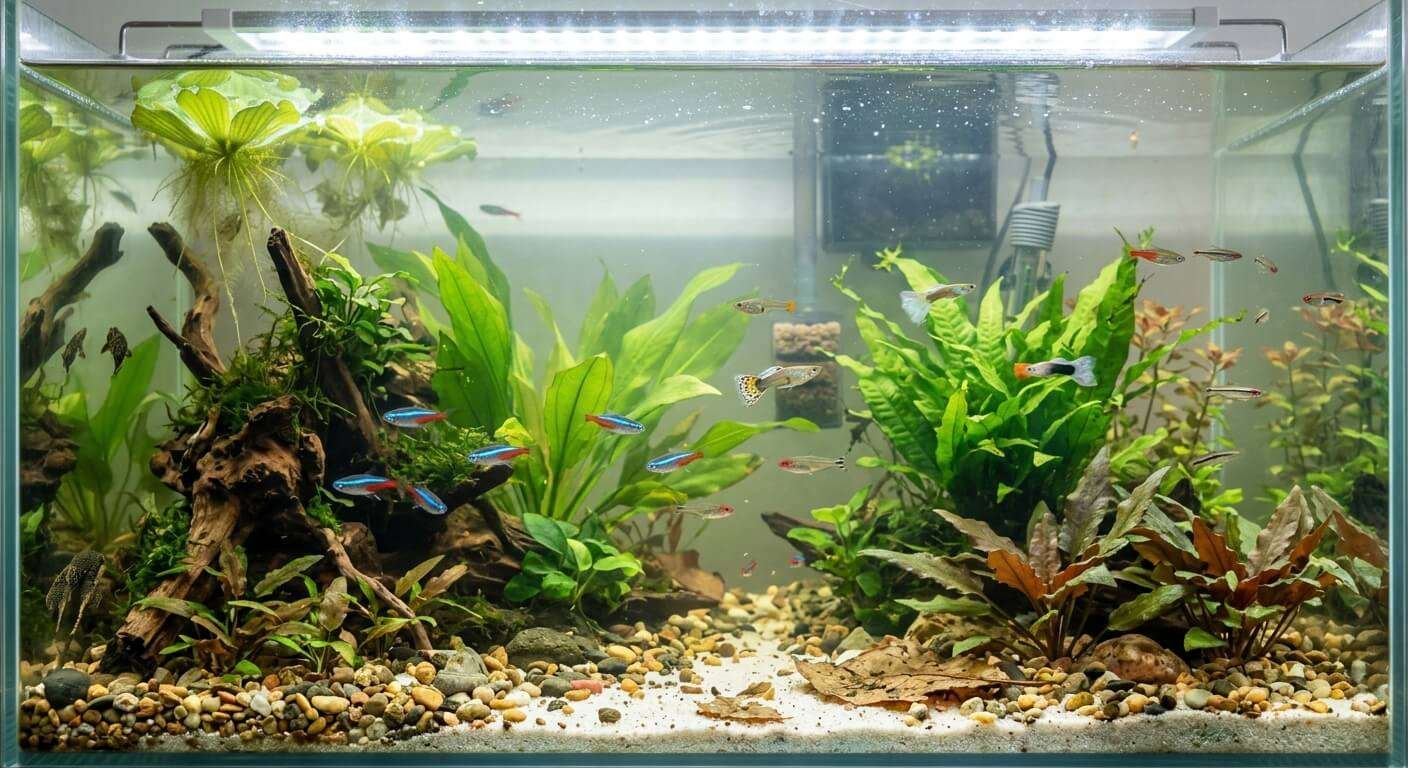
If you have ever looked at your aquarium and wondered, “why is my fish tank cloudy?”, you are not alone. Cloudy aquarium water is a common problem, especially in new tanks. The good news is that cloudy water does not always mean something is seriously wrong.
The key is to find out what is causing the cloudiness. It could be a bacterial bloom, leftover food, dirty gravel, algae, or a problem with your filter. Once you know the cause, fixing it becomes much easier.
Why Is My Fish Tank Cloudy?
A fish tank can become cloudy for several reasons. The most common causes include:
- Bacterial blooms
- New gravel or disturbed substrate
- Overfeeding
- Too much fish waste
- Poor or disrupted filtration
- Green water caused by algae
- Problems after a water change
- Decaying plants or other organic matter
The color and timing of the cloudiness can give you a useful clue about what is happening.
What Does the Cloudy Water Look Like?
White or Milky Cloudy Water
White or milky water is often caused by a bacterial bloom. This is especially common in a new aquarium while beneficial bacteria are becoming established.
A bacterial bloom can also happen in an established tank after a major change, such as cleaning filter media too aggressively, adding too many fish, or increasing the amount of waste in the aquarium.
If the tank is new, give the biological system time to become stable and check your water parameters regularly.
Green Cloudy Water
Green water is usually caused by an algae bloom. Too much light, direct sunlight, and excess nutrients can encourage algae to grow rapidly in the water.
Reducing excessive lighting and controlling waste and nutrients can help. Avoid placing the aquarium where it receives strong direct sunlight.
Gray or Dusty Cloudy Water
If your aquarium becomes cloudy shortly after adding gravel or sand, the problem may simply be tiny particles floating in the water.
This is common when new substrate has not been rinsed properly or when gravel is disturbed during cleaning.
A good mechanical filter can gradually remove these particles.
Brown or Tea-Colored Water
Brown or yellow-brown water is often linked to tannins released by natural materials such as driftwood and leaves. This is different from typical white bacterial cloudiness.
Whether you need to remove the tannins depends on the type of aquarium and the appearance you want.
Why Is My New Fish Tank Cloudy?
A cloudy new aquarium is very common. One major reason is the developing nitrogen cycle.
When an aquarium starts, beneficial bacteria need time to establish themselves. These bacteria help process fish waste and other organic matter. During this period, a bacterial bloom can make the water look white or milky.
Do not assume that clear water means the aquarium is fully cycled. Ammonia and nitrite levels are much more important indicators of water quality.
Test your water regularly, especially before adding more fish.
Why Is My Established Fish Tank Suddenly Cloudy?
If an established aquarium suddenly becomes cloudy, think about what changed recently.
Common causes include:
- Overfeeding
- Adding new fish
- Too many fish for the aquarium
- Dead plant material
- Uneaten food
- A dirty or poorly working filter
- Replacing too much filter media
- Deep or aggressive aquarium cleaning
- Disturbing the substrate
Finding the recent change can often help you identify the problem quickly.
Can Overfeeding Make Aquarium Water Cloudy?
Yes. Overfeeding is a common cause of poor water quality.
When fish receive more food than they can eat, the leftovers break down in the aquarium. This increases organic waste and can encourage bacterial growth.
Try feeding only what your fish can reasonably eat. Remove obvious uneaten food rather than allowing it to remain in the tank.
Less food waste means less waste for your aquarium’s biological system to process.
Why Is My Fish Tank Cloudy After a Water Change?
Cloudy water after a water change can happen for several reasons.
You may have disturbed the gravel, causing fine particles to enter the water. A major cleaning can also disturb the aquarium’s biological balance.
Another possibility is that the new water has not been properly treated.
When performing a water change, use an appropriate water conditioner if your tap water contains chlorine or chloramine, and avoid unnecessarily disturbing established filter media.
What Should I Do About Cloudy Fish Tank Water?
The best solution depends on the cause, but these steps are a good starting point:
1. Check the Water
Test ammonia and nitrite, especially if the tank is new or the cloudiness appeared suddenly.
Do not judge water quality only by how clear it looks.
2. Check Your Filter
Make sure the filter is running properly and that water is flowing through it.
Your filter performs both mechanical and biological jobs. Mechanical filtration helps remove particles, while biological filtration provides a place for beneficial bacteria to live.
Avoid replacing all established biological filter media at once unless there is a specific reason to do so.
3. Stop Overfeeding
If you have been feeding too much, reduce the amount and remove visible leftover food.
4. Look for Decaying Material
Check for dead leaves, dead fish, uneaten food, or other organic material that could be breaking down in the aquarium.
5. Control Aquarium Lighting
If the water is green, excessive light may be contributing to an algae bloom. Reduce unnecessary lighting and keep the aquarium away from strong direct sunlight.
6. Avoid Constant Cleaning
Repeatedly tearing down or aggressively cleaning the aquarium can make the problem worse, particularly when beneficial bacteria are still becoming established.
Give the aquarium time to stabilize while monitoring the water.
How Long Does Cloudy Aquarium Water Take to Clear?
There is no single answer because it depends on the cause.
Fine particles from gravel may settle or be removed by filtration relatively quickly. A bacterial bloom in a new aquarium can take longer as the biological system develops. Green water may continue until the excess light and nutrients causing the algae are controlled.
If the cloudiness continues for a long time, gets worse, or appears together with abnormal fish behavior, investigate the water quality instead of simply waiting.
Is Cloudy Water Dangerous for Fish?
Cloudy water itself does not automatically mean your fish are in danger. The bigger concern is what caused the cloudiness.
Pay particular attention if fish are:
- Gasping at the surface
- Breathing unusually fast
- Acting very weak or abnormal
- Suddenly dying
If these signs appear, test the water for ammonia and nitrite and address any water-quality problem promptly.
What You Should Not Do
When your aquarium becomes cloudy, avoid making several major changes at once.
Do not immediately:
- Tear down the entire aquarium
- Replace all your filter media
- Perform repeated unnecessary large cleanings
- Add more fish
- Overuse chemical water clarifiers without finding the cause
First identify the type of cloudiness and check your water parameters. A simple problem such as substrate dust needs a very different approach from an ammonia or nitrite problem.
Quick Guide to Cloudy Aquarium Water
| What you see | Possible cause | What to check |
|---|---|---|
| White or milky water | Bacterial bloom | Tank age, ammonia, nitrite |
| Gray or dusty water | Substrate particles | Recent gravel or sand changes |
| Green water | Algae bloom | Light and nutrients |
| Brown or tea-colored water | Tannins | Driftwood and leaves |
| Cloudy water + sick fish | Water-quality problem | Ammonia, nitrite, oxygen |
Frequently Asked Questions
Why is my fish tank cloudy but my fish seem fine?
The cause may be a normal bacterial bloom, suspended particles, or another non-emergency issue. However, testing ammonia and nitrite is still important because clear-looking water is not a guarantee of safe water.
How do I clear cloudy fish tank water?
First identify the cause. Check your water parameters, make sure the filter is working, reduce overfeeding, remove decaying material, and control excessive light if the water is green.
Why is my new aquarium cloudy?
A bacterial bloom is a common reason. New aquariums need time for beneficial bacteria to establish and create a stable biological cycle.
Should I change the water when my tank is cloudy?
It depends on the cause and your water-test results. A water change may be appropriate when there is a water-quality problem, but repeatedly changing water without understanding the cause may not solve a bacterial bloom or suspended-particle problem.
Final Thoughts
If you are asking “why is my fish tank cloudy?”, start by looking at the color, timing, and recent changes in your aquarium.
White or milky water often points toward a bacterial bloom, while green water is commonly linked to algae. Dusty water after adding gravel may simply be suspended particles.
Most importantly, do not judge aquarium health by appearance alone. Check ammonia and nitrite, keep your filter working properly, avoid overfeeding, and give a new aquarium time to establish its biological balance.
