

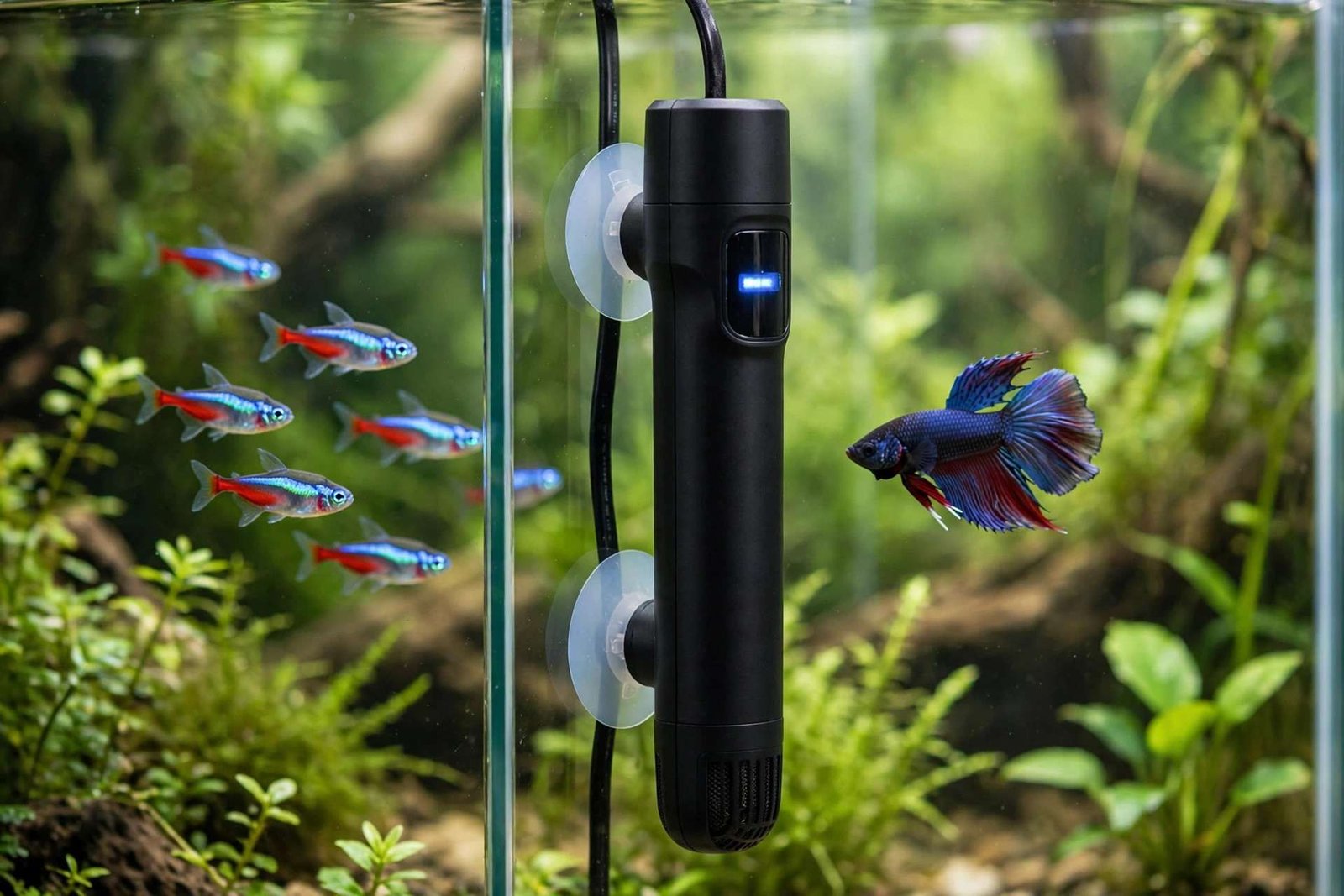
If your fish come from the tropics, a heater is not optional equipment. It is life support. Tetras, bettas, guppies, angelfish — all of them evolved in water that rarely dips below the mid-70s. When your room cools at night, and it always does, their immune systems slow down, ich shows up, and suddenly you are medicating instead of enjoying.
I have run a lot of heaters: cheap preset sticks, dial-twist glass tubes, the works. The hygger adjustable aquarium heater is the one I keep recommending, because it fixes the three things that annoy me about most heaters: you cannot see the actual water temperature, you have to put your arm in the tank to adjust it, and you only find out it failed when your fish are already stressed.
What Exactly Is the Hygger Adjustable Aquarium Heater?
It is a submersible heater built around an explosion-proof quartz glass tube, paired with a separate LED controller that sits outside the tank. Instead of a tiny dial you twist with wet fingers, buttons on the controller set the temperature anywhere from 59°F to 93°F, and the display shows the current water temperature and your target. It remembers your setting through power outages, and if the water gets too hot, too cold, or the heater ends up exposed to air during a water change, it cuts power and flashes an error code instead of cooking your stock.
The line comes in sizes from a 15-watt mini for a 1 to 2.5 gallon betta cube up to 1000-watt units for 130 to 260 gallon systems, in freshwater and saltwater alike — quartz does not corrode the way old coil heaters did.
Why Temperature Stability Matters More Than the Number
Beginners obsess over hitting exactly 78°F. Experienced keepers obsess over keeping it steady. A swing of five degrees overnight is harder on fish than a constant 74°F would ever be. It stresses their immune system, and stress is what lets parasites like ich get a foothold. That is the real job of a good heater: not hitting a magic number, but holding the line when the house cools at 3 a.m.
An adjustable heater earns its keep twice over: you can dial in exactly what your species needs — 80°F for discus, mid-70s for a community tank, cooler for white cloud minnows — and the external display means you actually check the temperature, since it stares at you from outside the glass.
Key Features Worth Knowing
External LED controller. Press SET, tap to your number, done — no wet hands, no guessing.
Live temperature readout. The display shows the current water temperature at a glance, with an indicator light for active heating.
59 to 93°F range with ±1°F accuracy. Wide enough for tropical community tanks, warm-water species, and even heat-treating white spot at higher temperatures.
Memory function. Holds your setting through a power cut and resumes where you left off instead of silently resetting to a factory default.
Explosion-proof quartz tube. Tougher than old glass coils, and the models come with a plastic guard so curious fish or clumsy turtles cannot touch the hot surface.
Multi-protection shutoffs. Cuts heating and flashes an error code if the water exceeds roughly 95°F, drops too low, or the heater runs dry — the difference between a scare and a disaster.
Fully submersible, vertical or horizontal. Suction cups are included. Tuck it behind decor or near the filter output so the warm water mixes evenly through the tank. A solid filter helps here — see our best fish tank filters guide for what to pair it with.
Sizing: What Wattage Does Your Tank Need?
The old rule is 3 to 5 watts per gallon, and it still works — but your room matters more than the math. A tank in a warm living room needs less; one in a drafty basement needs more. When in doubt, go one size up. A slightly oversized heater cycles less and holds temperature steadier.
Here are hygger’s own size recommendations:
| Wattage | Tank size |
|---|---|
| 15W | 1–2.5 gallons |
| 25W | 2–5 gallons |
| 50W | 5–10 gallons |
| 100W | 10–20 gallons |
| 150W | 20–25 gallons |
| 300W | 40–80 gallons |
| 500W | 66–135 gallons |
| 800W | 80–220 gallons |
| 1000W | 130–260 gallons |
For a standard 10-gallon community tank, the 100W is the sweet spot; for a 5-gallon betta setup, the 50W. The mini models (15 to 150W) have a slim profile that hides easily behind a filter — handy where a chunky heater would ruin the look. (If you are setting up that 10-gallon from scratch, our 10-gallon fish tank guide walks through the whole build.)
Setting It Up in 6 Steps
- Place it before you plug it in. Mount it with the suction cups where water flow is good — right by the filter output is ideal. Fully submerged, vertical or horizontal.
- Wait 20 to 30 minutes. Let the sensor acclimate to the water before powering up. Skipping this is how people get wild first readings.
- Plug in and set your temperature. Press SET on the controller, dial to your target, and leave it alone. The flashing stops once the setting is saved.
- Give it 24 hours. The tank needs a full day to stabilize. Do not chase the number in the first few hours.
- Verify with a separate thermometer. The step everyone skips and nobody should. A cheap thermometer on the opposite side of the tank tells you the real story — the heater’s display reads the water right next to the heater, which is always the warmest spot.
- Check it daily, at least with a glance. Make it a habit when you feed.
Honest Pros and Cons
What I like:
- The external controller: no wet arms, no guessing.
- Temperature accuracy is solid for the price. The ±1°F claim holds up in my experience.
- The safety shutoffs (dry-run and overheat) are the kind of thing you only appreciate once. Once is enough.
- The memory function means a power outage does not silently change your setup.
- Quartz tube plus guard feels noticeably sturdier than the old glass-tube heaters I started with.
What I would flag:
- The suction cups are the weak link, as with most heaters. Clean the glass before mounting and check them every few months.
- The display reads the temperature at the heater, not across the tank. Pair it with a thermometer on the far side.
- Big models (500W and up) need strong circulation to distribute heat evenly.
- It is a budget-friendly heater, not a lab instrument. On an expensive reef, you want redundancy regardless of brand.
Adjustable vs. Preset: Which Should You Buy?
Preset heaters lock in at one temperature, usually 78°F, and cost less. For a single betta in a 5-gallon where you will never need anything else, they are fine. But the moment you want anything different — 80 to 82°F for a discus grow-out, cooler water for goldfish, or a heat treatment for ich — a preset heater is a paperweight. The price gap is small, and the adjustable hygger gives you the display, the safety shutoffs, and the freedom to change your mind. Unless the tank’s livestock will never change, buy adjustable. For more on the factors that affect heater sizing (room temperature, lids, heat from other equipment), Aquarium Co-Op’s heater page is worth a read.
FAQs
Is the hygger adjustable heater fully submersible?
Yes. The heating tube goes completely underwater, vertical or horizontal, while only the controller stays outside. Never run it partially exposed — the dry-run protection will shut it off and flash an error code.
Can I use it in saltwater?
Yes. The quartz tube handles freshwater and saltwater alike.
What happens if the power goes out?
It resumes your saved setting when power returns. The tank still cools during the outage itself — no heater can fix that — so in cold climates plan accordingly.
Why is my heater flashing an error code or beeping?
That is the protection system doing its job: the heater is out of water, the temperature exceeded the safe limit near 95°F, or the water dropped below 59°F. Unplug it, check the water level and placement, let everything settle, then plug it back in.
How long do these heaters last?
A few years of steady service is typical for a well-placed submersible heater. If the suction cups wear out or the display starts drifting from your separate thermometer, replace it rather than trusting it.
Final Thoughts
The hygger adjustable aquarium heater is not fancy, and that is the point. It shows you the temperature, lets you change it without putting your arm in the tank, remembers its setting, and shuts itself off before a mistake becomes a tragedy. Match the wattage to your tank, park it near the filter flow, and always double-check with a real thermometer — then your fish get the one thing that matters most: a temperature that does not move.
