

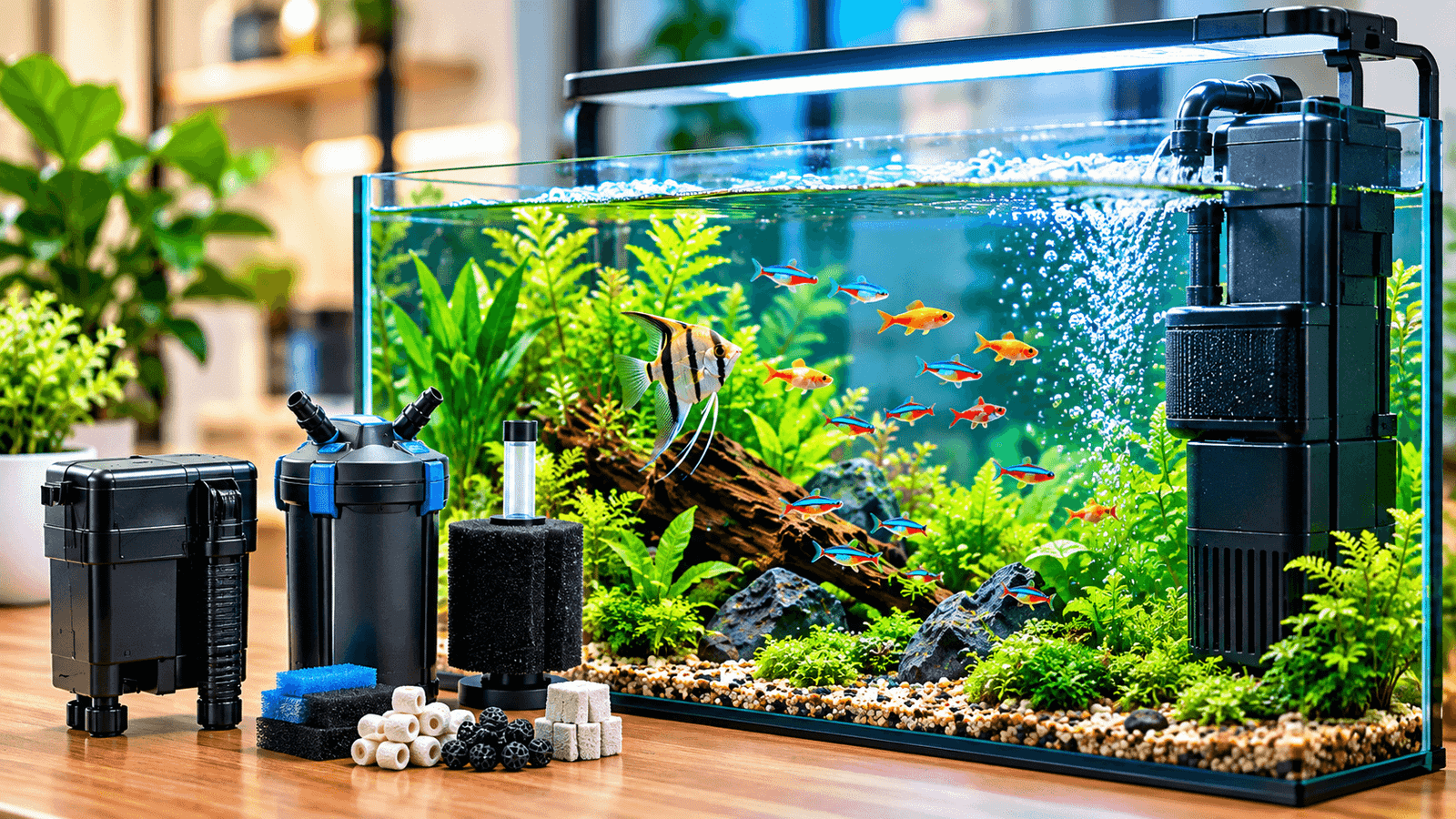
Choosing the best fish tank filter isn’t about grabbing the most powerful model off the shelf. The right filter depends on your aquarium size, the fish you keep, your tank’s bioload, and how much maintenance you’re realistically willing to do.
A small shrimp tank has completely different filtration needs than a heavily stocked aquarium full of goldfish or large cichlids. A filter that performs beautifully in one setup can create excessive current, waste space, or fail to provide enough biological filtration in another.
In this guide, we’ll break down every major filter type, help you match one to your specific fish and tank size, and point you toward some of the best-known models in each category — so you’re not just guessing based on the number printed on the box.
The 7 Best Fish Tank Filters for 2026
Enough theory — here are the actual filters. These are the models fishkeepers keep coming back to year after year, because they work without drama. They’re organized by what each one is genuinely best at, so jump straight to the one that fits your tank.
Jump to a pick: 1. AquaClear 70 (best overall) · 2. Seachem Tidal 75 (best modern HOB) · 3. Fluval 407 (best medium canister) · 4. Fluval FX6 (best for large tanks) · 5. Fluval 107 (best small canister) · 6. Marineland Penguin 350 (best budget) · 7. Double sponge filter (best for bettas and shrimp)
1. AquaClear 70 — Best Overall HOB Filter
The verdict: the HOB most experienced keepers buy once they stop experimenting.
Specs: Hang-on-back | Rated 40–70 gallons | 300 GPH | ~6W | Foam, activated carbon, and BioMax bio-media included
The AquaClear 70 has been around for decades, and there’s a reason fish stores still recommend it. The media basket is enormous for a hang-on-back, so you get real biological capacity instead of a thin disposable cartridge. The flow-control dial lets you calm it down for fish that dislike current, and because every piece of media is reusable, there’s no monthly cartridge tax. It’s quiet, dependable, and backed by a 2-year warranty.
The honest downside: it won’t restart itself after a power cut — you have to refill it by hand to get the siphon going again. The plastic housing also feels thinner than what you get on a premium canister.
Best for: 40–70 gallon freshwater community tanks where you want one dependable filter and minimal fuss.
Approx. price: $45–60
2. Seachem Tidal 75 — Best Modern HOB Filter
The verdict: the smartest-designed HOB you can buy right now.
Specs: Hang-on-back | Rated up to 75 gallons | 350 GPH | 8W max | 1.9 L media capacity
The Tidal 75 answers every complaint people had about old-school HOBs. It’s self-priming, so it restarts on its own after a power cut. The built-in surface skimmer eats that oily film off the water surface. A little peg pops up to remind you when cleaning is due, and there are separate dials for flow and skimmer/intake balance, plus clips to mount a heater out of sight.
The honest downside: the surface skimmer is picky about water level — let the tank run low and it gets noisy. It also costs more than the classic HOBs.
Best for: 40–75 gallon tanks where you want modern features and a film-free water surface.
Approx. price: $60–80
3. Fluval 407 — Best Canister for Medium Tanks
The verdict: serious filtration capacity that hides under your stand.
Specs: Canister | Rated up to 100 gallons | 383 GPH | ~15W | Multi-stage stacked media baskets
The 07 series is the best-selling canister line of all time, and the 407 shows why. It packs a huge amount of media into stacked baskets you can arrange however you like, runs quietly enough for a living room, and spare parts are easy to find years down the road. This is the filter for 55–100 gallon community or cichlid tanks where a HOB simply can’t hold enough bacteria.
The honest downside: cleaning a canister is a project compared to rinsing a HOB sponge. And it’s overkill — in both size and price — for small tanks.
Best for: 55–100 gallon community, planted, or cichlid tanks.
Approx. price: $230–280
4. Fluval FX6 — Best for Large Tanks and Heavy Bioloads
The verdict: when nothing else is enough, this is the answer.
Specs: Canister | Rated up to 400 gallons | 925 GPH | ~43W
The FX6 is the go-to for big tanks, goldfish-heavy setups, and large cichlids — the kind of bioload that eats lesser filters alive. Its massive media volume keeps water chemistry stable even when maintenance stretches a bit longer than planned. If you’re running 125 gallons or more, this is the shortlist of one.
The honest downside: expensive, heavy, needs real cabinet space underneath — and total overkill for anything under about 125 gallons.
Best for: 125–400 gallon tanks and messy, heavily stocked setups.
Approx. price: $330–380
5. Fluval 107 — Best Premium Small-Tank Canister
The verdict: canister-level silence and capacity for tanks where a HOB doesn’t suit.
Specs: Canister | Rated 10–30 gallons
Sometimes you want the quiet and media capacity of a canister on a small tank — no waterfall noise in a bedroom, no bulky box hanging off the back in an aquascape photo. The 107 delivers exactly that in a compact body built for nano and small setups.
The honest downside: it costs several times what a basic HOB costs for the same tank size, and the hoses look cluttered on a tiny tank.
Best for: 10–30 gallon bedrooms, offices, and aquascapes where silence and looks matter.
Approx. price: $130–170
6. Marineland Penguin 350 — Best Budget HOB
The verdict: the cheapest way to get genuinely strong filtration on a mid-size tank.
Specs: Hang-on-back | Rated up to 70 gallons | 350 GPH | ~8W | Three-stage filtration with Bio-Wheel
The Penguin 350’s Bio-Wheel gives you wet/dry biological filtration — bacteria colonizing a spinning wheel with huge surface exposure — at a price that undercuts nearly every competitor. Mechanical, chemical, and biological stages are all covered for less than a nice dinner out.
The honest downside: it’s bulkier than sleeker HOBs, and the Bio-Wheel eventually needs replacing with a brand-specific part.
Best for: budget builds and mid-size tanks up to about 70 gallons.
Approx. price: $35–50
7. Double Sponge Filter (Hygger or AQQA) — Best for Bettas, Shrimp, and Fry
The verdict: the humble workhorse of breeding and shrimp rooms everywhere.
Specs: Air-driven sponge | Rated up to ~40 gallons (size-dependent) | Needs a separate air pump (~3–5W)
A double sponge filter does three things beautifully. The gentle flow won’t stress bettas or suck up shrimp and fry. It doubles as aeration. And it’s the only filter type that keeps running on a battery air pump during a power cut. For the price of a pizza, a shrimp colony gets safe, reliable filtration.
The honest downside: it won’t polish water as crystal-clear as a HOB or canister, you buy the air pump and airline separately, and it’s not enough for messy, heavily stocked tanks.
Best for: bettas, shrimp, fry, breeding, and quarantine tanks.
Approx. price: $8–15 for the filter, plus $10–20 for an air pump
Filters at a Glance: Comparison Table
| Pick | Type | Tank Size | Flow | Best For |
|---|---|---|---|---|
| AquaClear 70 | HOB | 40–70 gal | 300 GPH | Best overall community tank |
| Seachem Tidal 75 | HOB | Up to 75 gal | 350 GPH | Modern features, surface skimming |
| Fluval 407 | Canister | Up to 100 gal | 383 GPH | Medium tanks, heavier bioload |
| Fluval FX6 | Canister | Up to 400 gal | 925 GPH | Large tanks, goldfish, big cichlids |
| Fluval 107 | Canister | 10–30 gal | Compact | Small tanks, silent operation |
| Marineland Penguin 350 | HOB | Up to 70 gal | 350 GPH | Budget mid-size tanks |
| Hygger/AQQA double sponge | Sponge | Up to ~40 gal | Air-driven | Bettas, shrimp, fry |
Prices above are approximate street prices as of October 2026 and move around — check current pricing before buying.
What Does an Aquarium Filter Actually Do?
An aquarium filter does more than one job. Good filtration removes physical waste from the water while also housing the beneficial bacteria your tank’s nitrogen cycle depends on.
Aquarium filtration generally falls into three categories:
- Mechanical Filtration
Mechanical filtration removes physical particles from the water. Foam, sponge, and filter floss trap things like:
Uneaten food
Fish waste
Plant debris
Dust and suspended particles
This is the part of filtration that visibly makes your water look clearer. Clean mechanical media regularly rather than letting it clog completely — packed media chokes water flow fast.
- Biological Filtration
Biological filtration is arguably the most important job any aquarium filter performs. Beneficial bacteria colonize sponge, ceramic rings, and other porous media, converting toxic ammonia and nitrite into safer compounds.
This is why replacing all your filter media at once is a mistake many beginners make — you risk wiping out the bacteria colony your whole aquarium relies on.
- Chemical Filtration
Chemical filtration uses materials like activated carbon or specialized resins to pull out specific dissolved substances — medication residue, odors, discoloration, or organics.
Carbon is useful for a specific purpose, not something every tank needs running 24/7. For most established aquariums, mechanical and biological filtration form the real foundation.
Looking for the best fish tank filters to keep your aquarium clean, clear, and healthy? The right filter can make a big difference in water quality and fish health. From powerful canister filters to simple hang-on-back and sponge filters, each type has its own benefits. In this guide, we’ll explore the top options for different tank sizes and fish setups, explain what to look for before buying, and help you choose a filter that fits your aquarium without wasting money.
The Best Types of Fish Tank Filters
There’s no single “best” filter for every aquarium — there are several proven filter designs, each suited to different situations.
- Hang-On-Back (HOB) Filters
A HOB filter clips onto the back edge of your tank, pulls water through media, and returns it to the aquarium.
Best for: beginners, community tanks, small-to-medium aquariums, and anyone who wants low-hassle maintenance.
HOB filters are popular because they’re easy to install, easy to access, and provide solid mechanical and biological filtration without eating up space inside the tank. Look for a model that lets you use reusable sponge and bio-media rather than locking you into disposable proprietary cartridges — brands like AquaClear and Fluval are well known for exactly this kind of flexible media basket.
Best overall use: a typical freshwater community aquarium where simplicity matters most.
- Canister Filters
Canister filters sit externally, usually below the tank, pulling water through hoses and multiple stacked layers of media before returning it.
Best for: large aquariums, heavily stocked tanks, big fish, planted tanks, and aquarists who want serious media capacity.
Their biggest advantage is sheer capacity — a canister can hold far more mechanical and biological media than a HOB, which matters once bioload climbs. Popular options in this category include the Fluval FX series and Eheim Classic canisters, both known for reliability in larger setups.
The tradeoff is maintenance time — cleaning a canister takes longer than rinsing a HOB sponge. For a small tank, that extra complexity often isn’t worth it; for a large or heavily stocked one, it usually pays off.
- Sponge Filters
Sponge filters are the simplest design available. An air pump pushes air through a tube into the sponge, and rising bubbles draw water through it — collecting debris and hosting bacteria along the way.
Best for: shrimp tanks, breeding tanks, fry, bettas, quarantine tanks, and small aquariums.
Their gentle flow is the big selling point, and because the intake is fully covered by sponge, there’s very little risk of pulling in shrimp or baby fish. Brands like Hygger and AQQA make widely used sponge filters for exactly these setups.
The downside: sponge filters don’t polish water as finely as more elaborate systems — but for a shrimp or fry tank, that trade-off usually doesn’t matter.
- Internal Filters
Internal filters sit inside the tank, powered by a submerged electric pump.
Best for: small aquariums, nano tanks, and setups where there’s no room for external equipment.
Their main drawback is that they take up visible space inside the tank and generally hold less media than an external system — but for a nano tank, that’s often an acceptable trade.

How Much Filter Flow Do You Actually Need?
One of the most common mistakes when choosing an aquarium filter is looking only at the gallon rating printed on the box.
A filter marketed for a certain tank size doesn’t automatically suit every aquarium of that size — because bioload matters more than volume.
Picture two 20-gallon tanks: one lightly stocked with small fish, the other packed with large, messy eaters and heavy feeding. Same water volume, very different filtration needs.
A common starting point is aiming for several turnovers of your tank’s total volume per hour — but the right number depends on your fish, aquascape, filter design, and the actual flow rate after media is installed (which is almost always lower than the number on the box).
So instead of asking “what filter is rated for my tank size?” — ask “what filter gives me enough biological capacity and the right water movement for what I’m keeping?” That’s the better question.
Don’t Confuse High Flow With Better Filtration
More powerful isn’t always better. Some fish enjoy strong circulation; others get stressed by it.
Watch your fish after installing any new filter. Signs the flow is too strong include:
Fish constantly fighting the current
Fish hiding behind decorations
Trouble swimming normally
Fish getting pushed around the tank
Fish sheltering in the same spot most of the day
If filtration capacity is good but current is excessive, you usually don’t need a weaker filter — you just need to diffuse or redirect the outflow with a spray bar or baffle.
How to Choose a Filter Based on Your Fish
Fish / Tank Type Recommended Filter
Betta fish Gentle sponge filter or low-flow HOB
Shrimp Sponge filter
Fry / breeding tanks Sponge filter
Goldfish High-capacity HOB or canister
Large cichlids Canister / high-capacity filtration
Community tanks (small) HOB or internal
Community tanks (large) Canister
Quarantine tank Sponge filter
Bettas do best with minimal turbulence — a sponge filter or a turned-down HOB works well. Shrimp and fry need gentle circulation and protected intakes, making sponge filters the clear winner. Goldfish produce heavy waste and need strong mechanical and biological capacity, even though they’re not aggressive swimmers. Large cichlids can disturb substrate and decor, so oversized mechanical and bio-capacity make maintenance far easier.
What Filter Media Should You Use?
A simple, effective media stack looks like this:
Mechanical media → Biological media → Optional chemical media
Mechanical media catches large particles before they ever reach the biological stage. Biological media provides the surface area bacteria need to establish. Chemical media (like carbon) gets added only when there’s a specific reason — medication removal, odor, discoloration.
The golden rule: don’t sacrifice your biological filtration just because a cartridge looks dirty. A dirty-looking sponge is often doing its job.
How Often Should You Clean Your Aquarium Filter?
There’s no universal calendar date that works for every filter — watch the equipment instead of the clock.
If flow noticeably drops, mechanical media is likely clogged. When cleaning sponge or bio-media, avoid harsh tap water — chlorine kills the bacteria colony you’ve spent weeks building. Instead, rinse reusable media in removed aquarium water during a routine water change.
Also check the impeller and intake regularly. A dirty impeller is a common (and easily fixed) cause of weak flow or unusual noise.
Why Is My Aquarium Filter Making Noise?
A noisy filter doesn’t necessarily mean the motor is dying. Common, fixable causes include:
Air trapped inside the filter housing
A dirty or worn impeller
Loose components or a vibrating lid
Low aquarium water level
Clogged media
An obstructed intake
Before assuming you need a replacement, clean the impeller, check the intake, reseat the filter properly, and confirm your water level is where it should be. Often a “broken” filter just needs five minutes of attention.
Should You Replace Your Filter Cartridge?
Be cautious with any instructions telling you to swap out all your media on a fixed schedule. If a cartridge contains established biological media, throwing it away removes beneficial bacteria along with the debris.
Reusable sponge and bio-media can be cleaned and reused for a long time. Activated carbon is the exception — replace it according to its intended lifespan, but don’t assume every tank needs carbon running permanently.
The goal isn’t buying new media constantly. It’s maintaining effective filtration while protecting your tank’s biological stability.
Best Fish Tank Filter: Quick Decision Guide
Your Aquarium Filter Type to Consider
Betta tank Gentle sponge or HOB
Shrimp tank Sponge filter
Fry / breeding tank Sponge filter
Small community tank HOB or internal
Medium community tank HOB
Large aquarium Canister
Heavy bioload Canister or multiple filters
Goldfish aquarium High-capacity filtration
Large cichlid tank Canister / high-capacity filtration
Quarantine tank Sponge filter
These are starting points, not rigid rules — stocking level, feeding habits, species, plants, and tank dimensions all shape the final decision.
Frequently Asked Questions
What is the best fish tank filter overall? For most freshwater community tanks, the AquaClear 70 is the safest all-around pick — it’s quiet, dependable, and the reusable media keeps long-term costs down. Step up to the Fluval 407 for larger tanks, or grab a double sponge filter for bettas and shrimp. See the 7 top picks above for the full breakdown.
Is a canister filter better than a HOB filter? Not universally — canisters offer more media capacity and suit large or heavily stocked tanks, but they take longer to clean. For small-to-medium community tanks, a HOB is often more practical.
Do I need a chemical filter (carbon) all the time? No. Carbon is useful for specific situations like medication removal or odor control, but most established tanks run fine on mechanical and biological filtration alone.
How often should I clean my fish tank filter? There’s no fixed schedule — clean mechanical media when flow noticeably drops, and rinse biological media gently in removed tank water, not tap water, to protect the bacteria colony.
What filter is best for a betta fish? A gentle sponge filter or a HOB filter with reduced flow works best, since bettas are sensitive to strong current.
Why is my fish tank filter so loud? Usually trapped air, a dirty impeller, a loose lid, or low water level — not a failing motor. Check these first before replacing the unit.
Final Verdict: What Is the Best Fish Tank Filter?
The best fish tank filter is the one that gives your specific aquarium enough mechanical and biological filtration without creating problems for your fish.
For beginners, a quality HOB filter (like an AquaClear or Fluval) offers the best mix of simplicity and performance. For shrimp, fry, bettas, and breeding setups, a sponge filter is hard to beat for its gentle flow. For larger or heavily stocked tanks, a canister filter (like a Fluval FX or Eheim Classic) gives you the media capacity to keep water quality stable.
Don’t choose a filter based on the number printed on the box. Think about the whole picture:
Tank size + fish species + bioload + feeding + desired flow + maintenance
Once you weigh those factors together, picking the right fish tank filter becomes a lot less complicated — and a lot more likely to keep your aquarium healthy for the long run.

13 Comments
Pingback: Best Aquarium Filters Guide: How to Choose the Right One (2026)
Pingback: Aquarium Maintenance: Complete Fish Tank Care Guide
Pingback: How Much Gravel for a Fish Tank? A Simple Guide by Tank Size - Fish Accessories
Pingback: 20 Fish With Big Lips: Pictures, Fascinating Facts & Care Guide
Pingback: What Fish Does Caviar Come From? The Surprising Answer
Pingback: Aquarium Air Pump Guide: How to Choose, Use & Set Up
Pingback: Peacock Fish Care Guide: Tank Size, Food, Water & Tank Mates
Pingback: 20-Gallon Fish Tank Guide: Best Fish, Setup & Cost (2026)
Pingback: 20 Gallon Fish Tank: The Complete Setup, Stocking & Care Guide
Pingback: 5 Gallon Fish Tank: The Complete Setup, Stocking & Care Guide
Pingback: 10 Gallon Fish Tank: The Complete Setup, Stocking & Care Guide
Pingback: Fish Food: The Complete Guide to Feeding Your Aquarium Fish - Fish Accessories
Pingback: Hygger Adjustable Aquarium Heater: Complete Review & Setup Guide