

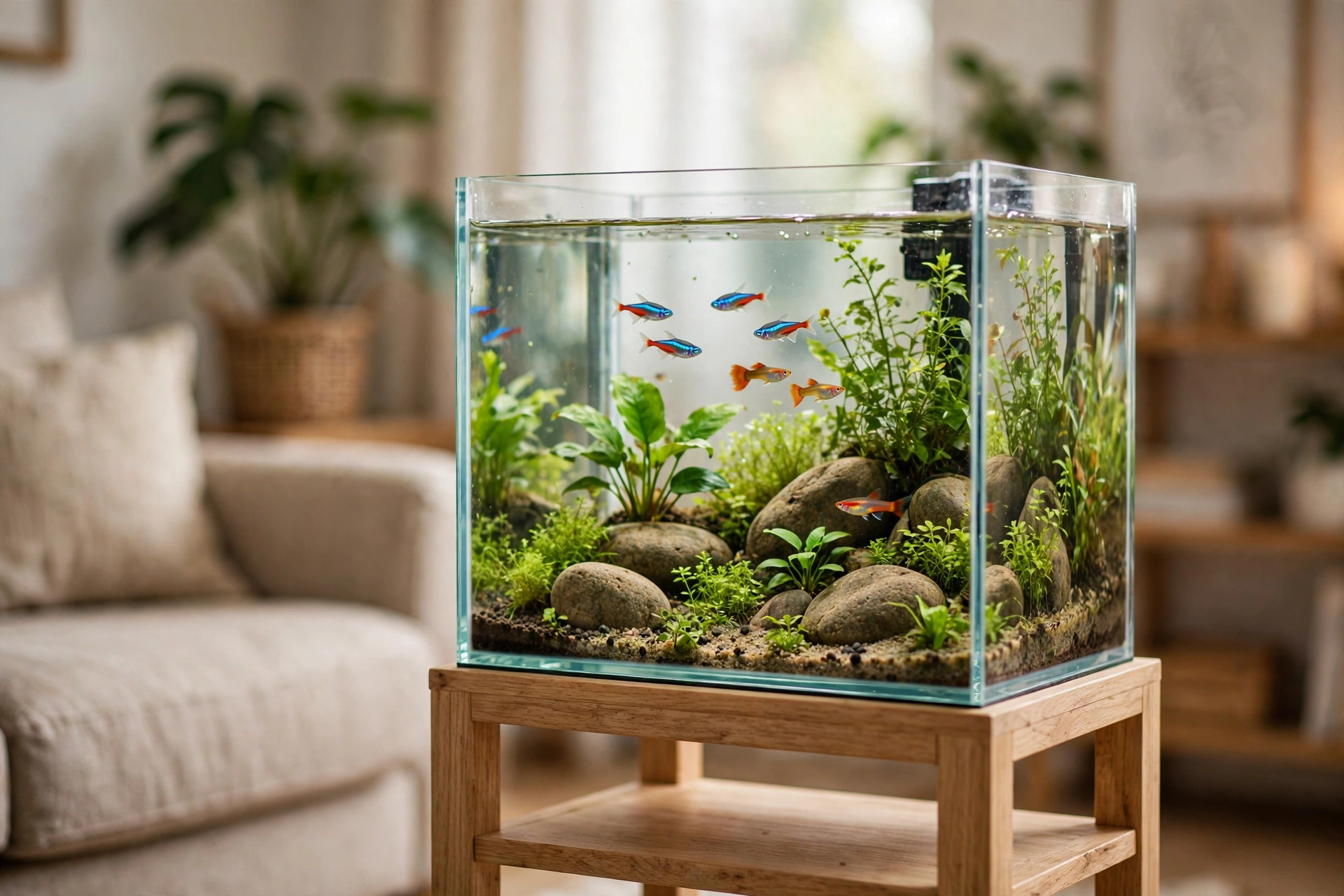
Why a 10 Gallon Tank Is the Perfect Starter
Walk into any pet store and the 10 gallon fish tank is the one you’ll see stacked by the dozen — it’s the best-selling aquarium size in the world. There’s a reason: it’s cheap, it fits on a dresser, and it’s the smallest tank that still gives beginners a real chance at success.
That last point matters. Anything under 10 gallons is genuinely hard to keep stable — temperature swings, ammonia spikes, and one forgotten water change can end a nano tank. The 10 gallon is where fishkeeping gets forgiving enough for a first-timer. This guide covers everything: the right equipment, how to set it up properly, what to stock it with, and the mistakes that kill most beginner tanks.
Price is the obvious draw — a basic 10 gallon kit often costs less than a single dinner out. But the real case is practical:
Small enough for anywhere. A filled 10 gallon weighs roughly 110 pounds, so it sits happily on a sturdy desk, dresser, or dedicated stand. No floor reinforcement, no special furniture. It fits in bedrooms, offices, and apartments where a bigger tank never could.
Big enough to stay stable. This is the size where water chemistry stops swinging wildly. Toxins dilute across 10 gallons of water instead of concentrating in 3 or 5. You get a margin for the beginner mistakes you will make.
Cheap to run. Water changes take ten minutes and a couple of buckets. A 50-watt heater sips electricity. Fish food, conditioner, and filter media all cost less at this scale.
Real stocking options. Unlike a 5 gallon (which is honestly a betta-or-shrimp tank), a 10 gallon supports a proper little community: a school of tetras, a betta with tank mates, or a planted shrimp colony. Enough variety to stay interesting for years.
The trade-off is honesty: it’s still a small tank. You can’t keep big fish, you can’t overstock it, and you do need to stay on top of maintenance. Respect the limits and it’s a fantastic aquarium. And if you have space for a bigger setup, stepping up to a 20 gallon fish tank gives you even more stability and stocking room — same beginner-friendly care, more options.
10 Gallon Tank Dimensions
The standard 10 gallon measures 20″ × 10″ × 12″ tall. It’s a rectangle, not a cube — and that shape is actually ideal. Fish swim side to side, not up and down, so the 20-inch length gives them usable swimming room, and the wide surface area helps oxygen dissolve into the water.
Some kits come as “tall” or bowfront variants. For fish, the classic rectangle beats tall every time — tall tanks look dramatic but give fish less swimming space and worse gas exchange per gallon.
Equipment You Need
A 10 gallon doesn’t need fancy gear, but it does need the right gear. Here’s the complete list:
Filter. A hang-on-back filter rated for 10–20 gallons is the standard choice. Alternatively, a small sponge filter driven by an air pump works beautifully in a 10 gallon — it’s cheap, gentle (great for bettas and fry), and the sponge itself becomes a bacteria hotel. Aim for turnover of 4–6 times the tank volume per hour, but keep the flow adjustable: tetras and bettas hate being blasted around. If you’re not sure which model to buy, our guide to the best fish tank filters compares real picks for every tank size.
Heater. A 50-watt adjustable heater is the sweet spot (roughly 5 watts per gallon). Adjustable is non-negotiable — preset heaters drift as they age, and in 10 gallons of water a few degrees of drift matters. Stick a cheap thermometer on the glass and glance at it daily.
Light. A basic LED hood or clip-on light is fine for fish-only tanks and easy low-light plants: Java fern, Anubias, Java moss, and Amazon swords all thrive under modest light. If you want a lush planted tank, step up to a proper plant light — but start simple and see if you catch the plant bug first.
Substrate. Gravel or sand, 1–2 inches deep. Sand looks natural and is kinder to bottom-feeders like corydoras. If you want live plants, either use a nutrient-rich planted substrate or push root tabs into regular gravel.
Water conditioner. Tap water contains chlorine or chloramine that kills both fish and the beneficial bacteria your tank depends on. A bottle of conditioner lasts ages at this tank size — a few drops per water change.
Test kit. The liquid API Freshwater Master Test Kit. Not the dip strips — they’re convenient and misleading. The liquid kit tells you the truth about ammonia, nitrite, nitrate, and pH, which is the difference between guessing and knowing your tank is safe.
Also grab: a small gravel vacuum (the mini size is perfect for a 10 gallon), a fish net, an algae scraper or magnetic cleaner, and a bucket that is used only for the aquarium — never soap, never cleaning chemicals.
How to Set Up a 10 Gallon Fish Tank: Step by Step
1. Choose the spot first. Level, sturdy, away from windows (sunlight = algae explosion) and away from doors that slam or speakers that thump. Remember: once filled, this tank weighs over 100 pounds. You’re not moving it.
2. Rinse everything with plain water. Tank, substrate, decorations. No soap — ever. Soap residue is toxic to fish and nearly impossible to rinse out completely.
3. Add substrate and decorations. Lay 1–2 inches of substrate, arrange rocks and driftwood while the tank is empty. Soak driftwood beforehand or it’ll float and tint your water tea-colored for weeks (harmless, but startling the first time).
4. Install the equipment. Hang the filter, place the heater near the filter output so warmth distributes evenly, position the light. Don’t plug anything in yet.
5. Fill it up. Put a small plate on the substrate and pour water onto it so you don’t blast a crater in your gravel. Add water conditioner as you fill.
6. Power up and leak-check. Plug in the filter and heater, confirm water flow, and watch the seams for drips over the next hour or so.
7. Cycle the tank — the step beginners skip. Your filter needs to grow a colony of beneficial bacteria that convert toxic ammonia (from fish waste) into nitrite, then into far less harmful nitrate. Without this colony, new fish swim in their own poison.
Do it fishless: add a small ammonia source (a pinch of fish food daily, or a few drops of pure ammonia) and test the water every day or two. You’ll watch ammonia rise and fall, then nitrite rise and fall, then nitrate climb. When a dose of ammonia converts fully to nitrate within 24 hours, you’re cycled. It takes 2–6 weeks. Boring, yes. But this single step is the difference between fish that live for years and fish that die in a week.
8. Add fish gradually. Start with a few hardy fish, wait a week or two, then add the next group. Dumping a full stocking list in on day one overwhelms the young bacteria colony and triggers the exact ammonia spike you just spent weeks avoiding.
How Many Fish in a 10 Gallon Tank? (Plus 4 Stocking Plans)
The honest answer: about 8–12 small fish, depending on species and how heavily filtered and planted your tank is. The old “one inch of fish per gallon” rule is a rough starting guess at best — a 2-inch active fish produces far more waste than a 2-inch snail, and some fish need swimming room the rule ignores.
Here are four stocking plans that actually work in a 10 gallon:
1. The classic community. 8–10 neon tetras (or ember tetras for a warmer color), plus 4–6 pygmy corydoras for the bottom. Peaceful, colorful, and the corys clean up leftover food. This is the most forgiving starter combination there is.
2. Betta + friends. One male betta, 6 harlequin rasboras or ember tetras, and a nerite snail or two. Skip this if your betta is aggressive — have a backup plan (even a plastic tub with a heater) in case he won’t share. Never two male bettas, ever.
3. The livebearer tank. 3–4 guppies or platies to start. Warning: livebearers breed like crazy. Start with males only unless you want 40 fish by spring — or keep one male to two females and accept that you’ll be rehoming fry.
4. Shrimp colony. 10–15 cherry shrimp plus a nerite snail. Nearly zero bioload, endlessly entertaining, and a planted shrimp tank is genuinely beautiful. The lowest-maintenance option on this list.
What not to put in a 10 gallon: goldfish (they grow to a foot long and are waste machines), angelfish, most gouramis beyond the dwarf/honey types, and anything labeled “semi-aggressive” at the store. If the store employee says “it’ll be fine,” get a second opinion — stores sell fish, not long-term outcomes.
10 Gallon Maintenance Schedule
Small tanks reward routine. The whole weekly routine takes about 15 minutes:
Weekly: 25–30% water change with the gravel vacuum. This is the single most important thing you do — it removes nitrates and replenishes minerals. Treat new water with conditioner and match the temperature roughly before adding it.
Weekly: Quick glass wipe and a glance at the thermometer, filter flow, and fish behavior. Fish acting oddly (gasping at the surface, clamped fins, hiding) is usually a water-quality problem — test immediately.
Monthly: Rinse filter media in old tank water from a water change — never tap water, which kills the bacteria colony. Replace chemical media (like carbon) if you use it; mechanical sponge media lasts years.
Monthly: Test the full parameter set (ammonia, nitrite, nitrate, pH) even when things look fine. Catching a slow nitrate creep beats discovering it during a fish emergency.
5 Beginner Mistakes That Kill 10 Gallon Tanks
1. Skipping the cycle. Covered above, worth repeating: the #1 killer. An uncycled tank is a fish graveyard with nice lighting.
2. Overstocking. The tank looks empty at first, so beginners keep adding “just one more.” Every fish adds waste. Stock slowly, test often, and stop when the plan says stop.
3. Overfeeding. Fish need far less food than you think — what they can eat in 2–3 minutes, once or twice a day. Uneaten food rots into ammonia. A hungry-looking fish is a healthy fish; a bloated tank is a dying one.
4. Too many water changes at once. A panicked 80% water change shocks fish with sudden parameter swings. Small, regular changes beat heroic rescues. The exception: a genuine emergency (like an ammonia spike), where big changes are the lesser evil.
5. Adding fish to “fix” algae. Plecos and “algae eaters” sold for this purpose mostly outgrow a 10 gallon or stop eating algae as adults. Algae is a light/nutrient balance problem — reduce light hours (6–8 per day is plenty), don’t overfeed, and keep up with water changes.
FAQs
Is a 10 gallon tank good for beginners?
Yes — it’s the smallest size that’s genuinely beginner-friendly. Smaller tanks swing too fast; a 10 gallon gives you a buffer against the mistakes every beginner makes, while staying cheap and easy to maintain.
How many fish can I put in a 10 gallon tank?
Roughly 8–12 small fish (tetras, rasboras, guppies), or one betta with a small school of peaceful tank mates. Stock gradually and let water tests — not impatience — tell you when the tank is at capacity.
Do I need a heater for a 10 gallon tank?
For tropical fish (tetras, bettas, guppies, corydoras), yes — they need 74–80°F, which most homes don’t hold consistently. A 50-watt adjustable heater is inexpensive insurance. Cold-water setups are possible but limit your stocking options severely.
How often should I clean a 10 gallon fish tank?
A 25–30% water change every week, plus a quick glass wipe. Filter media gets rinsed monthly in old tank water. Total time: about 15 minutes a week. Skip a week occasionally and you’ll survive; skip a month and you’ll have problems.
Can a 10 gallon tank hold a goldfish?
No — not even one, and not even temporarily. Fancy goldfish grow to 6–8 inches and common goldfish to a foot; they’re massive waste producers that need 30+ gallons minimum. A goldfish in a 10 gallon is stunted, sick, and short-lived.
How long does it take to cycle a 10 gallon tank?
2–6 weeks fishless, with daily or every-other-day testing. Bottled bacteria products can shorten this, but verify with your own test kit — don’t trust the bottle’s marketing timeline.

4 Comments
Pingback: 20 Gallon Fish Tank: The Complete Setup, Stocking & Care Guide
Pingback: Fish Food: The Complete Guide to Feeding Your Aquarium Fish - Fish Accessories
Pingback: 5 Gallon Fish Tank: The Complete Setup, Stocking & Care Guide
Pingback: 30 Gallon Fish Tank: The Complete Setup, Stocking & Care Guide