
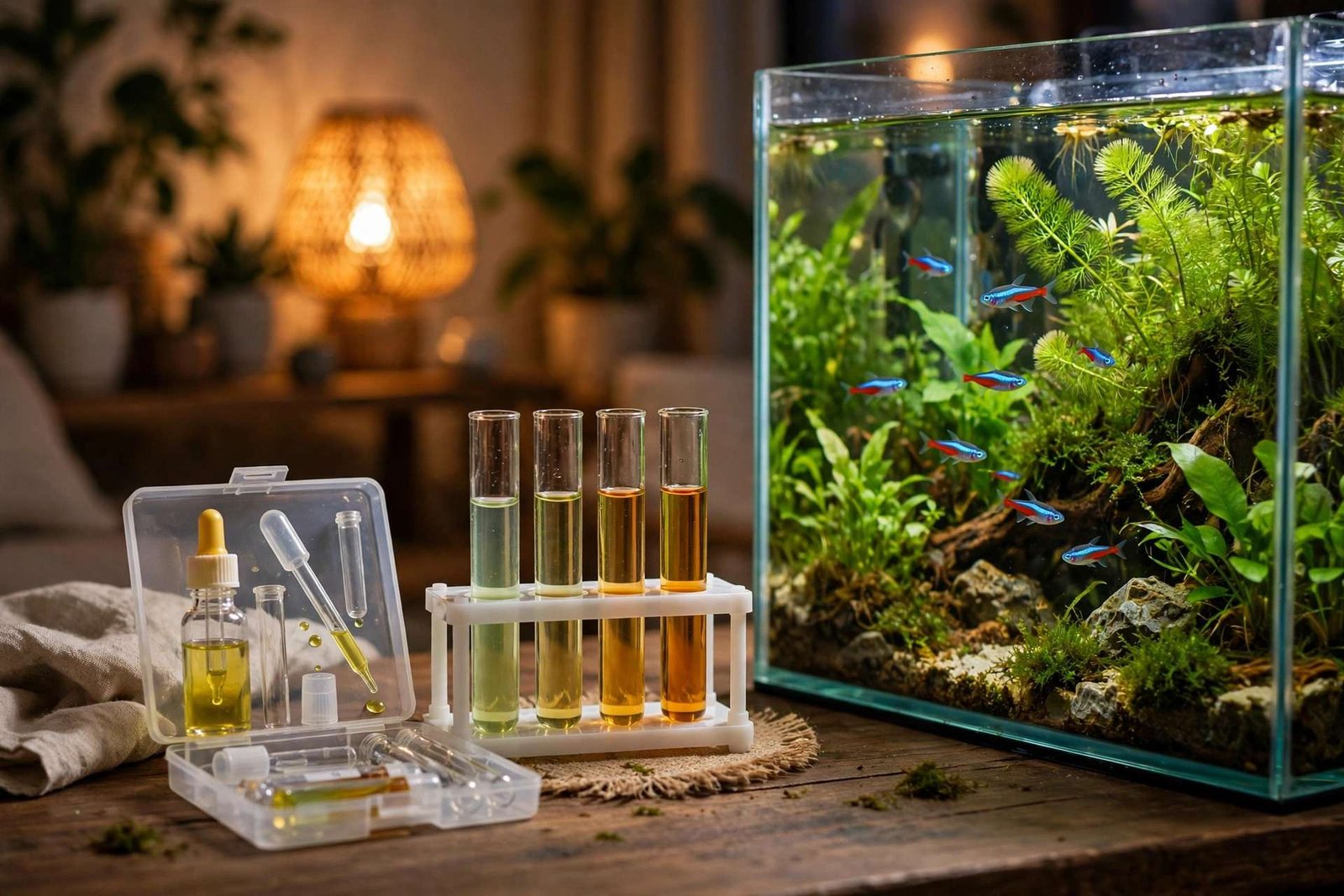
You dipped the test strip, squinted at the color chart, and there it was: 8.2. And the tank of neon tetras you’d been dreaming about suddenly felt like a mistake.
Take a breath. High pH is fixable – but half the advice online is either temporary or genuinely risky, and the difference matters because fish die from pH swings, not from high pH itself. This guide covers what actually works, gentlest method first.
The Short Answer
Most captive-bred freshwater fish do fine anywhere from 6.5 to 8.0 – stability matters far more than the exact number. If your pH sits above 8.0 and you’re keeping soft-water species (tetras, rasboras, discus, bettas, crystal shrimp), the safest fixes are driftwood and catappa leaves for a gentle drop, peat moss in the filter for a stronger natural pull, blending RO or distilled water into your water changes, and – most importantly – removing whatever is pushing your pH up in the first place. Chemical pH-down products work in minutes and wear off in hours; they’re the last resort, not the first.
Start By Testing the Right Things
Test your tap water, not just your tank
Fill a glass from the tap, let it sit out for 24 hours, then test it. Water companies often add buffers that make pH read high straight from the faucet, then it settles lower after a day of off-gassing. If your tap settles at 7.6 but your tank holds at 8.2, something in the tank is pushing it up – finding it is your real job, not buying chemicals.
Figure out whether you actually have a problem
African cichlids and livebearers – guppies, mollies, platies, swordtails – genuinely want hard, alkaline water. For them, 8.0+ is home, not a problem. Soft-water fish – tetras, rasboras, discus, most South American species, and Caridina crystal shrimp – prefer roughly 6.0 to 7.0.
Worth saying plainly: the easiest way to “fix” pH is to match your fish to your water in the first place. And if you’re running a nano setup, test more often – small water volumes swing faster than big ones, which our small fish tank guide covers in detail.
Find Out What’s Pushing Your pH Up
Adding acids to a tank that’s constantly generating alkalinity is like bailing a boat without plugging the leak. The usual culprits:
- Limestone, seiryu stone, Texas holey rock, and other calcium-rich rocks – the number one hidden cause.
- Crushed coral or aragonite substrate – excellent if you want high pH, a nightmare if you don’t.
- Concrete ornaments, some gravels, even certain “natural” sands.
The vinegar test: pull out a suspect rock, let it dry, drip plain white vinegar on it. Fizzing means it’s leaching carbonates into your water. If your decor fails the test and you want soft water, replace it – no amount of driftwood will out-fight a dissolving rock.
7 Safe Ways to Lower pH in an Aquarium
Tried in this order, from gentlest to strongest.
1. Driftwood and catappa leaves
Driftwood and Indian almond (catappa) leaves release tannins – weak natural acids that nudge pH downward and tint the water a warm tea color. Expect a gradual drop of maybe 0.2 to 0.5 – slow is exactly what you want. The tea color looks strange to beginners, but it’s literally what blackwater fish evolved in. If you can’t stand the tint, activated carbon in your filter pulls the color out.
2. Peat moss in the filter
A mesh bag of aquarium-safe peat moss tucked into your filter is the classic soft-water trick. It can pull pH down a full point or more. Rinse it well before it goes in, or your tank will look like weak coffee for a week. Replace it every month or two – exhausted peat does nothing. If you’re wondering where the bag goes, our best fish tank filters guide shows which filter types have room for extra media.
3. Blend RO or distilled water into water changes
Reverse-osmosis or distilled water has almost no minerals, so mixing it with your tap water for changes dilutes both KH and pH. Start with a 50/50 blend and retest after a couple of weeks. Never swap to pure RO water overnight, and don’t run a tank on it straight – fish need some dissolved minerals to regulate their bodies, so remineralize or keep mixing. Breeders and shrimp keepers swear by this, because it lowers the mineral load instead of fighting it.
4. Remove the culprit rock or substrate
If the vinegar test fizzed, nothing you add wins long-term. Pull the rock, swap limestone gravel for inert sand or plain gravel, and watch the pH settle over the next week or two. Fixing the cause beats dosing the symptom.
5. CO2 injection (planted tanks only)
Injected CO2 forms carbonic acid in water and drops pH – often a full point in a well-run planted tank. The catch: it only drops while the CO2 runs, so you get a daily swing unless injection is dead consistent, and it does nothing about your KH. A tool for planted-tank people, not a general pH solution.
6. Active buffering substrate
Aquasoils made for planted or shrimp tanks actively absorb KH and hold pH in the mid-6s. They’re fantastic for Caridina shrimp or discus breeding setups – and expensive enough that nobody buys one casually.
7. Chemical pH-down products (last resort)
They work in minutes – and wear off in hours if your KH is high, which it almost always is when pH is high. The result is a pH roller coaster, and those swings stress fish far more than a stable high pH does. If you go this route anyway: dose half of what the bottle says, test, and wait a full day before touching it again.
Meet KH – The Reason Your pH Won’t Budge
Here’s the chemistry in one paragraph: KH (carbonate hardness) is your water’s buffer. High KH locks pH in place – that’s why the chemical “didn’t work” and the driftwood barely moved the needle. Every method above either works with KH (peat, RO dilution, removing carbonate sources) or fights against it (acids, pH-down). Lowering pH without first cutting high KH is like pushing a door that swings shut behind you. If you want to go deeper, Aquarium Co-Op’s water chemistry guide explains the whole pH/GH/KH relationship in plain language.
Mistakes That Hurt Fish More Than High pH Ever Will
- Chasing a perfect number. Test weekly, adjust gradually, and accept 7.6 if it never moves. Stable and slightly high beats “ideal” and unstable.
- Big single-dose changes. Never move pH more than about 0.2 to 0.3 in a day.
- Running pure distilled or RO water with no remineralization. Zero-mineral water is chemically unstable and biologically wrong for fish.
- Dosing household acids blindly. Vinegar, lemon juice, “just a capful” – uncontrolled acids crash pH and rebound hard. Keep the vinegar for the rock test.
- Changing five things at once. Add driftwood OR start RO blends, test for two weeks, then decide what to do next. Otherwise you’ll never know what worked.
What If Your pH Is Too Low?
The mirror image: a mesh bag of crushed coral in the filter raises KH and pH gently and holds it there; a small dose of baking soda in the change water does the same – about a teaspoon per 50 liters is a common starting point, added slowly and tested before repeating. This breakdown of GH, KH, and buffering covers both directions in detail.
FAQs
What is the ideal pH for a freshwater aquarium?
For most community fish, 6.5 to 7.5. African cichlids and livebearers prefer 7.5 to 8.5; soft-water species like tetras and discus prefer 6.0 to 7.0.
Can I use vinegar to lower my aquarium’s pH?
No. Vinegar is an uncontrolled acid – it drops pH fast, rebounds faster in buffered water, and the dose is guesswork. Use vinegar only for the rock test described above, never as a tank additive.
How fast can I safely lower pH?
No more than about 0.2 to 0.3 pH units per day. Fish need time to adjust their internal chemistry to the water around them.
Will driftwood alone lower my pH enough?
For mild cases, often yes – expect 0.2 to 0.5. If your tap water is very hard (high KH), driftwood alone won’t cut it; combine it with RO water blends or peat.
Why does my pH keep bouncing back up?
Either your KH is high enough to buffer every change, or something in the tank – usually rocks or coral substrate – keeps adding alkalinity. Test your KH, run the vinegar test, fix the source.
