

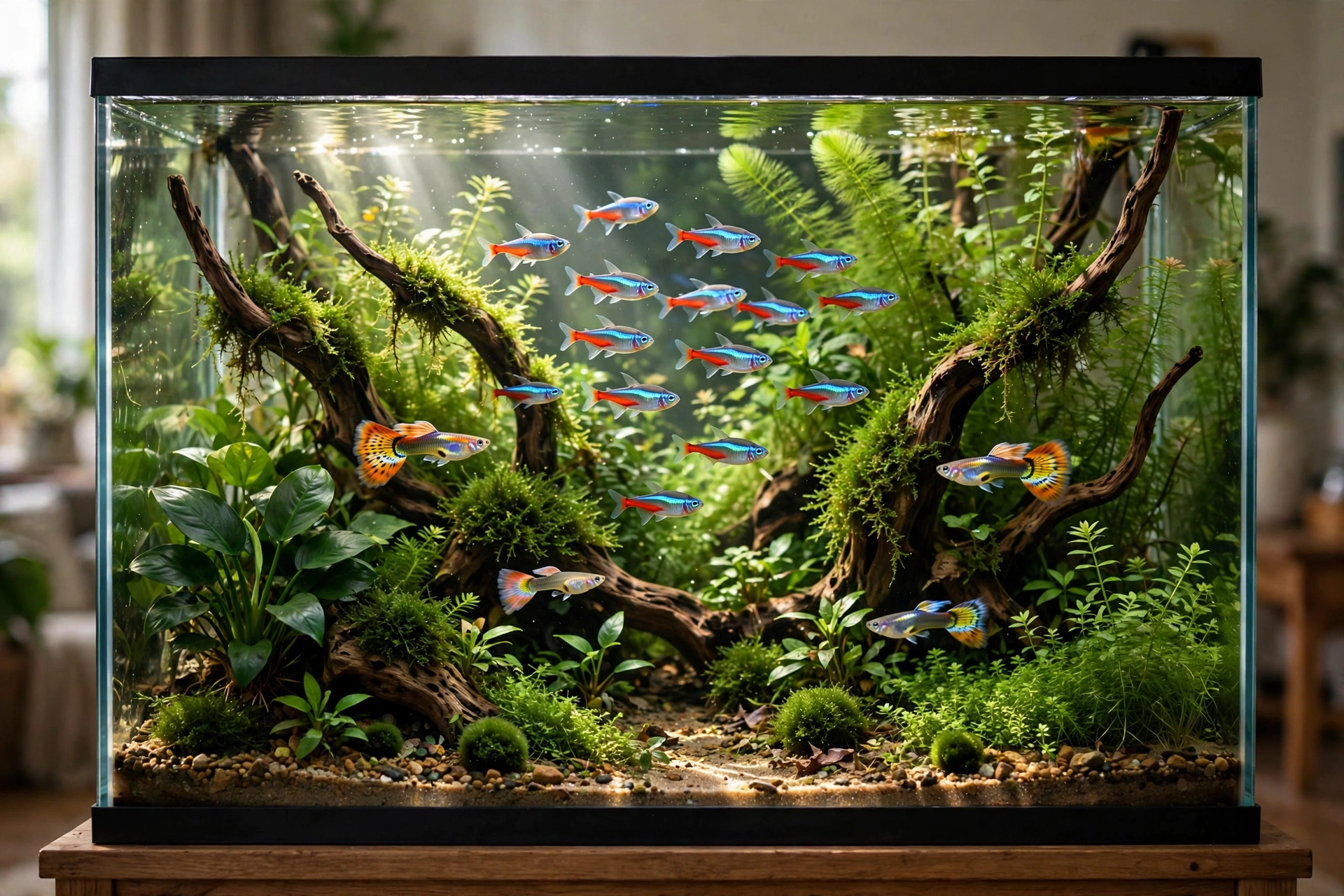
If you’re thinking about getting into fishkeeping — or upgrading from that tiny bowl on your desk — a 20 gallon fish tank is one of the best choices you can make. It’s big enough to keep the water chemistry stable, small enough to fit in a bedroom, and it unlocks stocking options a 10 gallon simply can’t handle.
I’ve helped plenty of beginners set up their first 20 gallon, and the difference between a tank that thrives and one that turns into a headache comes down to the same few things: the right equipment, a proper cycle, and not adding too many fish too fast. This guide covers all of it.
Why a 20 Gallon Tank Is the Perfect Size
Here’s what nobody tells beginners: smaller tanks are actually harder to keep. In a 5 gallon, one missed water change can spike ammonia overnight and wipe out your fish. A 20 gallon gives you a buffer — mistakes that would be fatal in a nano tank become minor, fixable problems.
At the same time, it doesn’t demand a huge commitment. A filled 20 gallon weighs around 170–200 pounds, so it sits on a proper aquarium stand without floor concerns. Water changes take fifteen minutes. Running costs stay low.
It’s also where your options open up: a lively schooling community, a centerpiece fish with tank mates, or a planted aquascape that looks like living art. And if a 20 feels like too much commitment, our 10 gallon fish tank guide covers the smaller, cheaper option — the world’s best-selling tank size.
20 Gallon Tank Dimensions: High vs. Long
20 gallon high: 24″ × 12″ × 16″ tall. Smaller footprint, good when space is tight.
20 gallon long: 30″ × 12″ × 12″ tall. The one most experienced keepers recommend. Fish swim horizontally, so the extra length gives schooling fish real room to move — plus more surface area means better oxygen exchange.
If you have the space, buy the 20 long. Your fish will use every inch of it.
Equipment You Need
You don’t need the priciest gear, but you do need the right gear:
Filter. A hang-on-back filter rated for 20–30 gallons, or a small canister filter if the budget allows. Sponge filters work great too and are gentle on small fish. Aim for turnover of 4–6 times the tank volume per hour without blasting fish around. If you’re unsure which model to buy, our guide to the best fish tank filters breaks down real picks for every tank size.
Heater. A 100-watt adjustable heater is the sweet spot (rough rule: 5 watts per gallon). Always adjustable, never preset — presets drift. Add a separate thermometer to double-check.
Light. A basic LED is fine for fish-only setups and easy plants like Java fern, Anubias, and Java moss. Heavily planted tanks need a proper plant light, but start simple.
Substrate. Gravel or sand both work. Sand looks natural and is kinder to bottom-dwellers like corydoras, whose barbels wear down on rough gravel. For live plants, use a nutrient-rich substrate or root tabs under gravel.
Water conditioner. Non-negotiable. Tap water contains chlorine or chloramine that kills fish and beneficial bacteria. A few drops per water change does it.
Test kit. The liquid API Freshwater Master Test Kit — not strips, which are misleadingly inaccurate. Testing ammonia, nitrite, nitrate, and pH is how you know your tank is actually safe. This is the item beginners skip and shouldn’t.
Also grab: a gravel vacuum, a fish net, an algae scraper, and a bucket used only for the aquarium.
How to Set Up a 20 Gallon Fish Tank: Step by Step
1. Pick the spot first. Level, sturdy surface, away from direct sunlight (sunlight equals an algae farm) and away from slamming doors or thumping speakers. Once it’s filled, you’re not moving it.
2. Rinse everything. Tank, substrate, decorations — plain water only. No soap, ever. Soap residue is toxic and nearly impossible to rinse out fully.
3. Add substrate and hardscape. Lay 1.5–2 inches of substrate, sloping slightly higher at the back. Arrange rocks and driftwood now while the tank is empty. Soak driftwood first or it’ll float and tint the water tea-colored (harmless, but surprising).
4. Install equipment. Hang the filter, place the heater near good water flow so heat distributes evenly, position the light. Don’t plug in yet.
5. Fill it up. Set a plate on the substrate and pour onto it so you don’t crater your gravel. Add conditioner as you fill.
6. Start everything and check for leaks. Plug in filter and heater, confirm water flow, and watch the seams for an hour or so.
7. Cycle the tank — the big one. Your tank must grow beneficial bacteria that convert toxic ammonia from fish waste into nitrite, then into far less harmful nitrate. Skipping this is the number one reason beginners lose fish.
Go fishless: add a small ammonia source (pure ammonia, or decaying fish food) and test daily. You’ll watch ammonia spike, then nitrite spike, then both fall to zero as nitrate rises. When dosed ammonia fully converts to nitrate within 24 hours, you’re cycled. This takes 2–6 weeks. It feels like forever. Do it anyway — your fish stay alive because of it.
8. Add fish slowly. Start with a few hardy fish, wait a week or two, then add more. A full stocking list on day one overwhelms the young bacteria colony and triggers an ammonia spike.
Best Fish for a 20 Gallon Tank
A 20 gallon — especially the long — gives you real choices. Combinations that work long-term:
Classic community: 10–12 neon or cardinal tetras, 6 corydoras, 1 honey gourami as centerpiece, plus a mystery snail. Peaceful, colorful, active at every tank level.
Livebearer tank: 4–6 guppies or platies, 8 harlequin rasboras, 6 otocinclus for algae. Note: guppies breed readily — go males-only unless you want a population explosion.
Betta community: one male betta with 8 ember tetras and 5–6 kuhli loaches. Works with a calm betta, but keep a spare 5 gallon as backup in case yours is a grump. Never two males together.
Shrimp paradise: cherry shrimp in mixed colors plus snails, lightly planted. Mesmerizing and nearly zero-maintenance once established.
Research each species’ adult size, temperament, and water needs before buying — and treat fish store advice as a starting point, not gospel.
How Many Fish Can You Keep?
The “one inch of fish per gallon” rule is a rough starting point, not a law. Twenty 1-inch fish is too many if they’re messy eaters, and no rule covers a fish that grows to 10 inches.
Stock by adult size, bioload, and behavior instead. Slim schooling fish like tetras have a light bioload — a school of 10–12 is fine. Chunky fish produce far more waste per inch. Bottom-dwellers need floor space, not just volume.
Leave headroom: a tank at 70–80% of comfortable capacity is more stable, more forgiving, and looks better than a packed one. If nitrates climb past 40 ppm between weekly water changes, the tank is telling you it’s full.
Maintenance Schedule
Consistency beats intensity.
Weekly (15 minutes): test the water, change 20–25% with a gravel vacuum (it pulls waste from the substrate as you go), refill with temperature-matched conditioned water, wipe the glass if algae is building.
Monthly: rinse filter media in old tank water — never tap water, since chlorine kills your beneficial bacteria. Check the heater and filter intake for gunk. Trim dead plant leaves.
Every few months: inspect equipment. Heaters fail eventually, and one stuck “on” can cook a tank — your separate thermometer is the early warning. Replace filter media only when it’s falling apart; rinsing is usually enough.
If maintenance ever feels like a chore, you’re likely overfeeding or overstocked — fix the cause, not the symptom.
Common Beginner Mistakes
Skipping the cycle. “My fish died within a week” is almost always new tank syndrome — ammonia poisoning in an uncycled tank.
Overstocking on day one. Even cycled, add fish gradually so bacteria catch up with each new bioload.
Overfeeding. The hobby’s most common mistake. Fish need what they eat in about two minutes, once or twice daily. Uneaten food rots, spikes ammonia, and feeds algae.
No heater for tropical fish. Room temperature swings with the weather. Tetras and guppies at 68°F are stressed fish with weak immunity. Hold tropical tanks at 74–78°F.
Incompatible tank mates. That peaceful-looking cichlid will eat your neons. The cute two-inch “algae eater” might be a common pleco that grows to two feet. Research before buying, every time.
Washing things in tap water. Filter media, decor, substrate — rinse in old tank water or dechlorinated water only.
FAQs
How long does cycling take? Usually 2–6 weeks fishless. Seeded filter media from an established tank can cut it to days — ask a local fishkeeping club.
Can a betta live in a 20 gallon? Absolutely — a male betta with peaceful tank mates makes a great centerpiece. Avoid other bettas and fin-nippers.
What does a full setup cost? Roughly $150–$300 new (tank, stand, filter, heater, light, substrate, conditioner, test kit). Local fishkeeping groups selling used gear can halve that.
Do I need an air pump? Not necessarily — a hang-on-back filter agitating the surface provides enough oxygen for most setups. It helps in heavily stocked or warm tanks.
How often should I clean it? Weekly 20–25% water changes plus monthly filter maintenance. Constant emergency cleanings mean something upstream needs fixing.
Final Thoughts
A 20 gallon hits a sweet spot few sizes manage: forgiving enough for beginners, big enough for interesting stocking, small enough to live with. Set it up patiently, cycle it properly, stock it thoughtfully, and you’ll own a slice of underwater life as relaxing to maintain as it is to watch.
The best tank isn’t the biggest or priciest — it’s the one still healthy and bringing you joy a year from now.
If you’re ready for more stocking room, step up to a 30 gallon fish tank for a true community setup.

2 Comments
Pingback: 10 Gallon Fish Tank: The Complete Setup, Stocking & Care Guide
Pingback: Fish Food: The Complete Guide to Feeding Your Aquarium Fish - Fish Accessories