

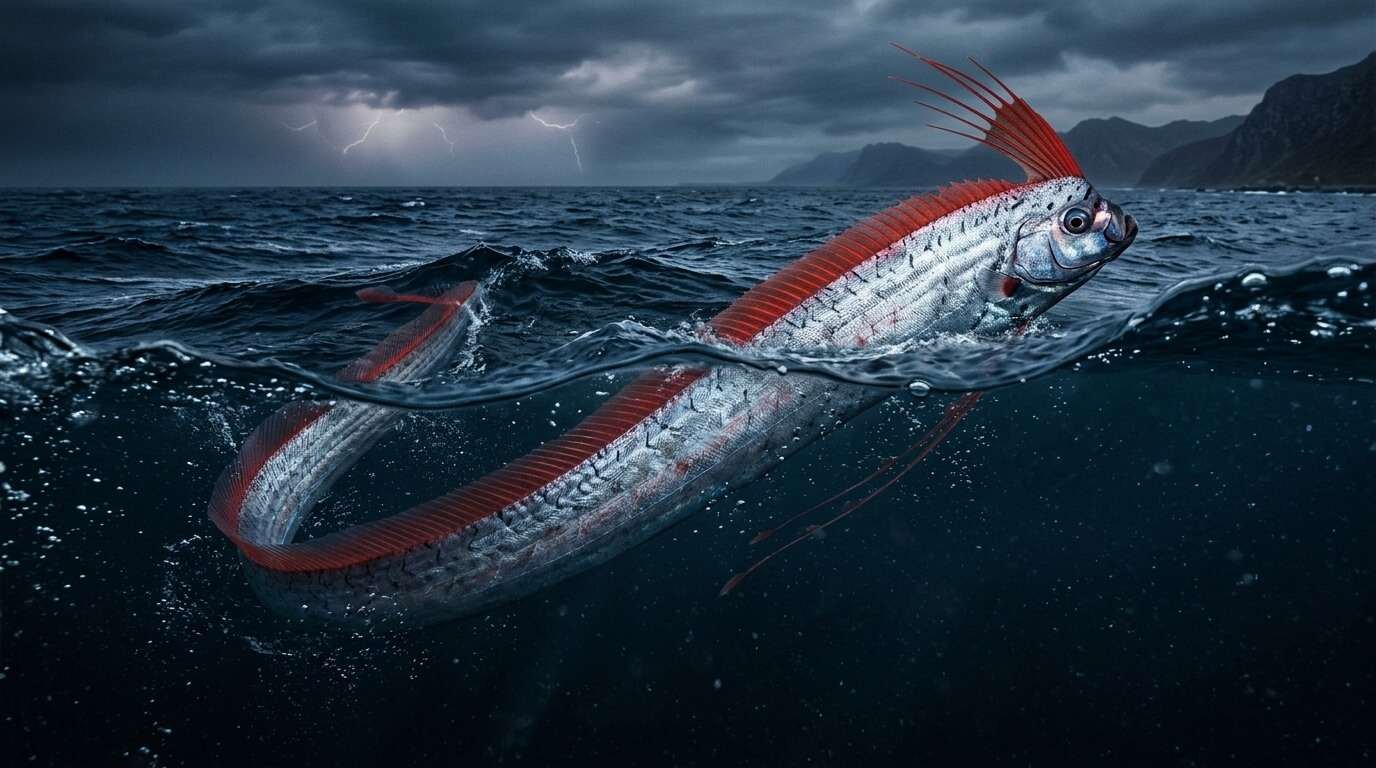
Have you ever heard of a fish that can warn us about impending earthquakes? It sounds like a creature from ancient ocean folklore, but the doomsday fish is very real.
The name refers to the giant oarfish, a rare deep-sea creature famous for its long, ribbon-like body. Beyond its unique look, it carries a deep connection to Japanese legends about earthquakes and natural disasters.
But can an oarfish actually predict an earthquake? Science says no—there is no reliable evidence to support this claim.
What Is the Doomsday Fish?
The doomsday fish is another name for the giant oarfish (Regalecus glesne).
- Size & Appearance: Oarfish are the longest bony fish in the ocean. They usually grow over 30 feet long, with maximum reports reaching 36 feet. Their long, silver, ribbon-shaped bodies are capped with a striking crimson dorsal fin and large eyes.
- Diet: Despite their intimidating look, oarfish are gentle filter feeders. They mainly consume plankton, krill, and tiny crustaceans, along with occasional small squid and jellyfish.
Why Is It Called the “Doomsday Fish”?
The nickname stems from tradition rather than science.
In Japanese folklore, the oarfish is called Ryugu no tsukai (“Messenger from the Sea God’s Palace”). According to legend, seeing an oarfish near the shoreline signals an incoming disaster, particularly an earthquake or tsunami.
Seeing a giant, silver, snake-like creature with a bright red crest emerging from the deep ocean made it easy for ancient communities to associate the sight with ominous events.
Can Oarfish Actually Predict Earthquakes?
No. There is no scientific proof connecting oarfish behavior to seismic activity.
The legend gained widespread attention when several oarfish washed ashore in Japan before the devastating 2011 Tōhoku earthquake and tsunami. While this coincidence strengthened the myth, coincidence does not equal causation.
Multiple scientific studies have analyzed stranding records against earthquake dates and found no statistical relationship. Consequently, oceanographers and seismologists do not treat oarfish sightings as earthquake warnings.
Where Do Oarfish Live?
Oarfish inhabit the ocean’s mesopelagic zone (also known as the twilight zone), residing between 200 and 1,000 meters (660 to 3,300 feet) below the surface.
Because NOAA identifies the mesopelagic layer as one of the ocean’s least explored regions, live oarfish encounters remain extremely rare.
Why Do Oarfish Wash Up on Beaches?
Beaching remains one of the most intriguing aspects of oarfish behavior. While there isn’t a single reason for every occurrence, scientists attribute surface sightings to:
- Illness or Injury: Sick or dying oarfish lose the strength to swim against deep currents.
- Disorientation: Strong ocean currents can push their long bodies into shallow waters.
- Inability to Navigate Shallows: Their bodies are built for deep-water floating, not maneuvering near shorelines and crashing waves.
While a beaching is unusual, it points to biological or environmental distress—not an upcoming earthquake.
The 2024 California Oarfish Sighting
In August 2024, kayakers and snorkelers spotted a 12-foot oarfish at La Jolla Cove in California. It marked only the 20th documented oarfish in California since 1901.
Coincidentally, a mild earthquake struck the region around the same time, reigniting online debate. However, researchers who examined the specimen confirmed that the timing was purely coincidental.
Doomsday Fish: Myth vs. Science
| Popular Belief | Scientific Reality |
| Predicts Earthquakes | No scientific or statistical link exists. |
| Surfaces deliberately before disasters | Moves upward due to illness, disorientation, or ocean currents. |
| Dangerous to humans | Harmless filter feeder. |
| Beaching is an omen | Driven by biological or environmental factors. |
Are Oarfish Dangerous to Humans?
No. Oarfish pose zero threat to humans. Despite their massive length, they lack large teeth and feed exclusively on tiny marine life.
Final Thoughts
The doomsday fish is an extraordinary deep-sea creature whose mythical status is built on ancient folklore rather than scientific truth. While seeing a 30-foot ribbon fish near the shore is a rare sight, it is not an indicator of an approaching earthquake. The real science behind deep-sea life is far more fascinating than the myth itself.
Frequently Asked Questions
What is the doomsday fish?
The doomsday fish is the nickname for the giant oarfish (Regalecus glesne), the world’s longest bony fish.
Can an oarfish predict earthquakes?
No. Scientific studies show no connection between oarfish strandings and earthquakes.
Why are oarfish called doomsday fish?
The name originates from Japanese folklore, which views the fish as a messenger warning of impending natural disasters.
How deep do oarfish live?
They live in the mesopelagic zone, roughly 200 to 1,000 meters (660 to 3,300 feet) deep.
Are oarfish dangerous?
No. They are harmless filter feeders that eat krill, plankton, and small marine organisms.
