

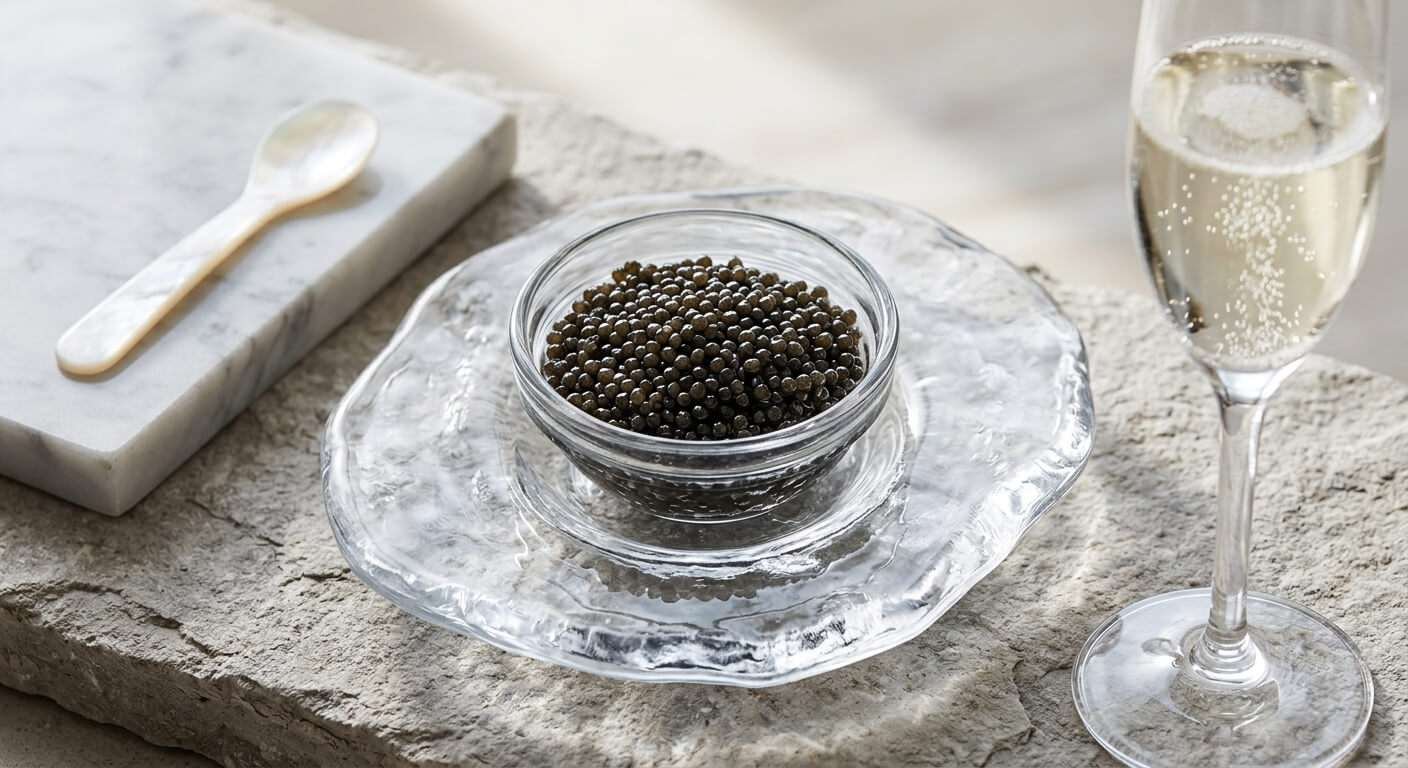
Caviar comes from sturgeon fish. More specifically, true caviar is made from the salted eggs, or roe, of female sturgeon. Some of the best-known sturgeon used for caviar include Beluga, Ossetra, Sevruga, Siberian sturgeon, and Kaluga.
Many people also call salmon roe, trout roe, or lumpfish roe “caviar,” but these are not true sturgeon caviar. They are fish roe from different species.
What Fish Does Caviar Come From?
True caviar comes from the eggs of female sturgeon. Sturgeon are ancient fish belonging to the family Acipenseridae.
There are several sturgeon species that produce caviar, and each can produce roe with different egg sizes, colors, textures, and flavors.
The most commonly known types include:
| Sturgeon | Common Caviar |
|---|---|
| Beluga sturgeon | Beluga caviar |
| Ossetra sturgeon | Ossetra caviar |
| Sevruga sturgeon | Sevruga caviar |
| Siberian sturgeon | Siberian or Baeri caviar |
| Kaluga sturgeon | Kaluga caviar |
| Sterlet sturgeon | Sterlet caviar |
So, when someone asks, “What fish is caviar from?”, the simple answer is sturgeon.
What Is the Difference Between Caviar and Fish Roe?
The words caviar and roe are sometimes used interchangeably, but they do not mean exactly the same thing.
Roe means the eggs of fish and other marine animals. Many different fish produce roe.
Caviar, in its traditional and commonly accepted sense, refers to processed roe from sturgeon.
For example:
- Sturgeon eggs → true caviar
- Salmon eggs → salmon roe
- Trout eggs → trout roe
- Lumpfish eggs → lumpfish roe
- Capelin eggs → capelin roe or masago
This distinction is important because a product can look like caviar without actually being sturgeon caviar.
Which Sturgeon Fish Produce Caviar?
Beluga Sturgeon
Beluga sturgeon (Huso huso) is one of the most famous fish associated with caviar. Beluga caviar is known for its relatively large eggs and delicate texture.
Beluga sturgeon can take many years to reach maturity, which is one reason genuine Beluga caviar has traditionally been considered a luxury food.
Ossetra Sturgeon
Ossetra, also spelled Osetra or Oscietra, refers to caviar traditionally obtained from Ossetra sturgeon.
Its eggs can vary in color from dark brown to lighter golden shades. Ossetra caviar is popular because of its firm texture and distinctive flavor.
Sevruga Sturgeon
Sevruga caviar traditionally comes from the Sevruga sturgeon (Acipenser stellatus).
Its eggs are generally smaller than those of Beluga and Ossetra. Sevruga is another well-known traditional type of sturgeon caviar.
Siberian Sturgeon
Siberian sturgeon (Acipenser baerii) is widely used in modern caviar farming.
Its roe is often sold as Siberian caviar or Baeri caviar. Because Siberian sturgeon is suitable for aquaculture, it is an important source of farmed caviar.
Kaluga Sturgeon
Kaluga sturgeon (Huso dauricus) is another important caviar-producing species. Kaluga caviar is sometimes compared with Beluga because of its relatively large eggs and luxurious reputation.
Is Salmon Caviar Real Caviar?
Salmon roe is not true sturgeon caviar.
Salmon produce eggs that are commonly sold as salmon roe. In some places, these eggs may be called salmon caviar in everyday or commercial language.
Salmon roe is usually larger and more brightly colored than many types of sturgeon caviar. It is commonly orange or reddish and is often served with sushi and other seafood dishes.
The key difference is the fish species:
Sturgeon eggs = true caviar
Salmon eggs = salmon roe
The same idea applies to trout and lumpfish eggs.
Is Trout Roe Caviar?
Trout roe is also not true sturgeon caviar.
Trout produce small eggs that are usually orange or reddish in color. Like salmon roe, trout roe can be used as a garnish or served with seafood dishes.
It may sometimes be marketed using the word “caviar,” but it is still roe from trout rather than traditional sturgeon caviar.
What Fish Is Black Caviar From?
The term black caviar usually refers to dark-colored caviar, especially genuine sturgeon caviar.
However, “black” describes the appearance rather than the fish species. Different sturgeon species can produce eggs in different shades, including gray, brown, dark gray, and black.
Some non-sturgeon fish roe can also be dark or processed to look like caviar. Therefore, the fish species should be checked if you want genuine sturgeon caviar.
Where Does Caviar Come From?
Caviar has a long history connected with sturgeon from areas around the Caspian Sea and Black Sea. These regions were historically famous for producing highly valued sturgeon caviar.
Today, the caviar industry has changed considerably. Because wild sturgeon populations have faced pressure from fishing and habitat changes, modern caviar production increasingly comes from sturgeon farms and aquaculture.
Farmed sturgeon are raised until the females reach maturity and can produce roe. The eggs are then carefully harvested and processed into caviar.
Is Caviar Made From Male or Female Fish?
Caviar is made from the eggs of female sturgeon.
Male sturgeon do not produce eggs, so they cannot produce caviar. Female fish must reach reproductive maturity before their eggs can be harvested.
Sturgeon are slow-growing fish, and some species can take many years to mature. This long production cycle is one factor that contributes to the cost of high-quality caviar.
Why Is Caviar So Expensive?
Caviar can be expensive for several reasons.
First, sturgeon are slow-growing fish. Farmers may need to care for them for years before female fish are mature enough to produce roe.
Second, raising sturgeon requires suitable water conditions, food, space, and long-term management.
Third, harvesting and processing the roe requires careful handling. The eggs need to remain intact and maintain their quality.
Finally, conservation rules and restrictions on wild sturgeon have changed the availability of traditional caviar.
Is Modern Caviar Farmed?
Yes. Farmed caviar is now an important part of the modern caviar industry.
Sturgeon farming allows producers to raise fish in controlled environments instead of depending entirely on wild populations.
Farmed caviar can come from species such as Siberian sturgeon, Ossetra-related sturgeon, and Kaluga. The exact species depends on the producer and region.
When buying caviar, checking the species and source can help you understand what you are actually purchasing.
Caviar vs. Fish Roe: Quick Comparison
| Product | Source | True Sturgeon Caviar? |
|---|---|---|
| Beluga caviar | Beluga sturgeon | Yes |
| Ossetra caviar | Ossetra sturgeon | Yes |
| Sevruga caviar | Sevruga sturgeon | Yes |
| Siberian caviar | Siberian sturgeon | Yes |
| Kaluga caviar | Kaluga sturgeon | Yes |
| Salmon roe | Salmon | No |
| Trout roe | Trout | No |
| Lumpfish roe | Lumpfish | No |
| Masago | Capelin | No |
Frequently Asked Questions
What fish does caviar come from?
True caviar comes from the eggs of female sturgeon. Common caviar-producing species include Beluga, Ossetra, Sevruga, Siberian sturgeon, and Kaluga.
Is caviar fish eggs?
Yes. Caviar is processed and salted fish eggs, or roe, from sturgeon. Not all fish eggs are considered true caviar.
Is salmon caviar real caviar?
Salmon eggs are usually called salmon roe. They are not true sturgeon caviar, although the term “salmon caviar” is sometimes used commercially.
What is the most famous caviar fish?
Beluga sturgeon is one of the most famous fish associated with traditional caviar. Ossetra and Sevruga are also well-known caviar-producing sturgeon.
Does caviar come from wild fish?
Historically, much famous caviar came from wild sturgeon. Today, a significant amount of caviar comes from farmed sturgeon because of conservation concerns and restrictions on wild sturgeon fishing.
Do male sturgeon produce caviar?
No. Caviar comes from the eggs of female sturgeon. Male sturgeon do not produce roe.
Final Answer
If you want the simplest answer to “What fish does caviar come from?”, it is sturgeon.
True caviar comes from female sturgeon, with Beluga, Ossetra, Sevruga, Siberian, and Kaluga among the best-known caviar-producing species. Salmon, trout, lumpfish, and other fish also produce roe, but their eggs are not traditional sturgeon caviar.
Understanding the fish species behind the product makes it much easier to tell the difference between genuine caviar and other types of fish roe.
